Supporting Women Radio Operators: Joan W1DLC

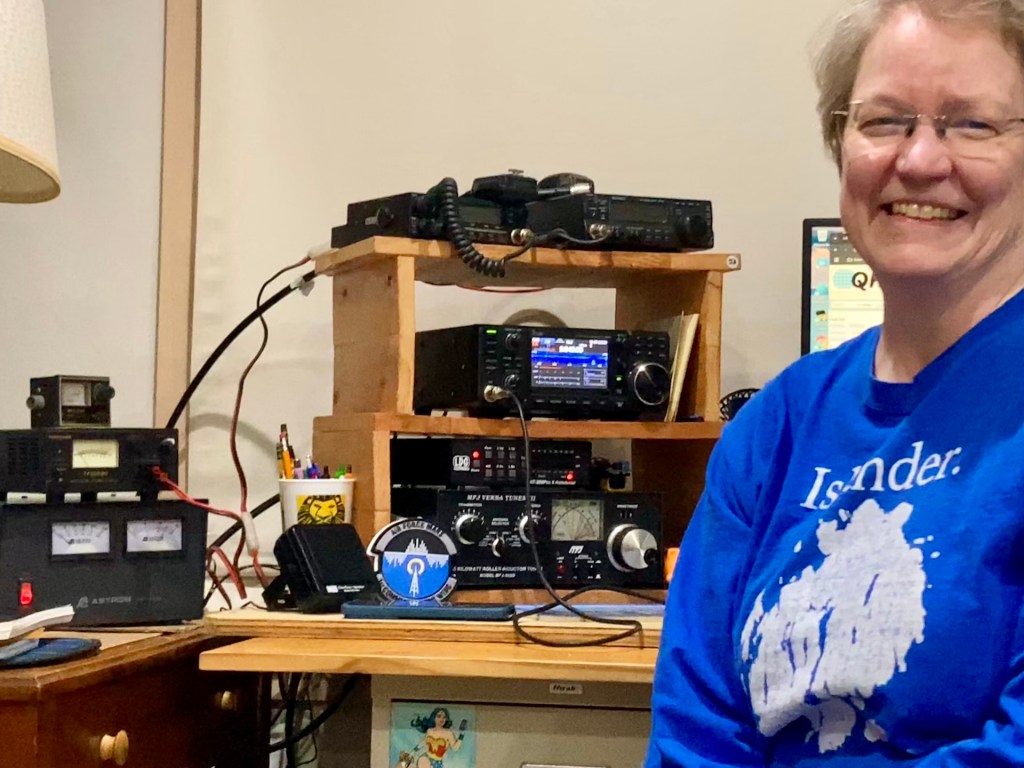
It’s common thing at any ham event in this region to see Joan W1DLC representing the Women Radio Operators of Maine. You’ll find her at hamfests, the Maine ARRL State Convention, and the Ellsworth Ham Radio Symposium. For several years now it has been her mission to promote ham radio to women. She has discovered that women, and men, are surprised and pleased to see that there is such a group. Many have remarked that they know a female ham who isn’t active that might benefit from knowing other female hams in the area. These conversations provide the fuel to continue representing women operators in such a visible way.

The Women Radio Operators of Maine are well represented at numerous ham radio gatherings.

The presence of women, or YLs (Young Ladies), in ham radio activities is increasing. It’s growing more common to hear female voices on the air. For example, YL POTA Day, corresponding with International Women’s Day, has gained a large following. A Facebook group called “Ham Radio Women” currently has 4.6K members. In the contesting world, women are participating at all levels, such as Katie KE8LQR who often works SSB and CW for Tim Duffy (of DX Engineering) at K3LR, and Pia DL7PIA who was the 2024 Youth Champion in the CQ DX Marathon program. Women are taking educational roles, as demonstrated by those leading courses for the Long Island CW Club. One of the most active organizations supporting women is the international Young Ladies Radio League (YLRL), formed in 1939. The YLRL has a presence at many large ham radio events and hosts an international gathering every few years. They sponsor numerous scholarships, host contests, maintain a website with many helpful resources (ylrl.net), and publish an extensive bimonthly newsletter called the “YL Harmonics.” 
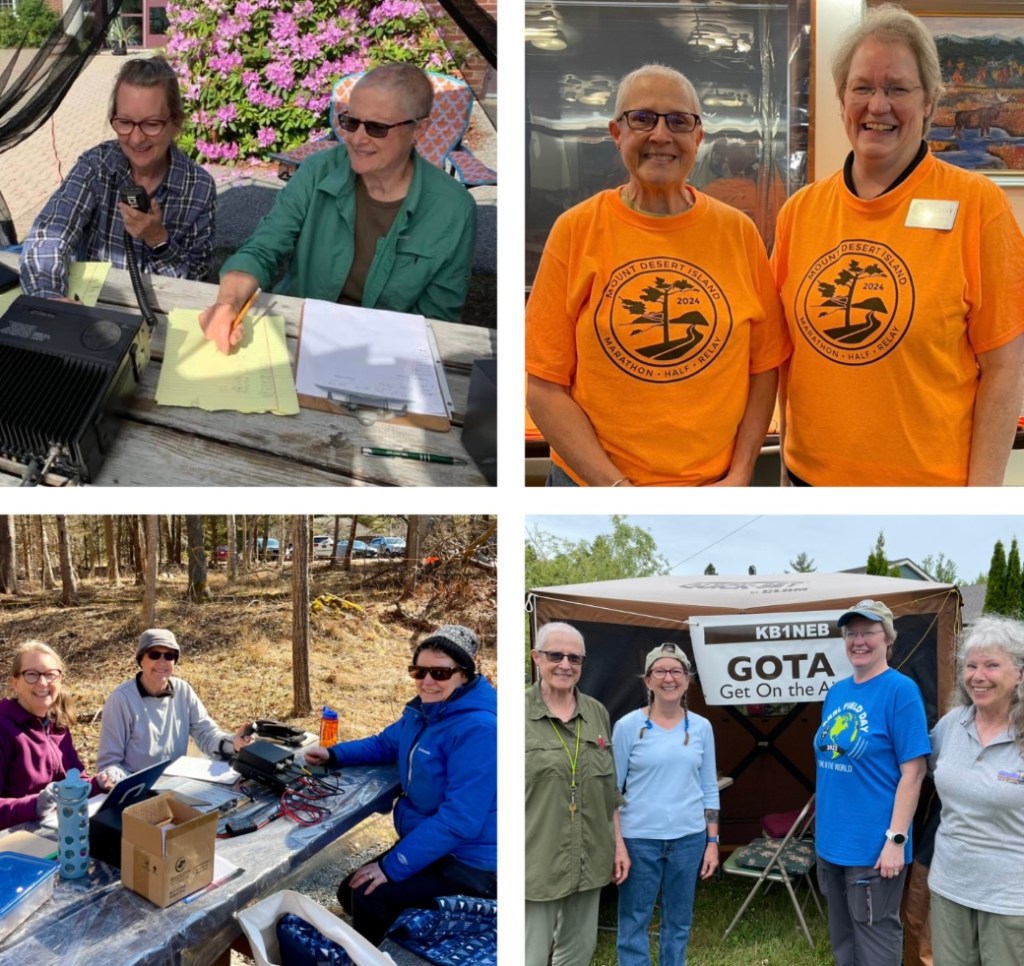
From mentoring at the Get On The Air station at Field Day, to working along side women in the EAWA, to organizing a YL POTA Day, Joan provides comforting support to women operators at all levels.

While large scale resources such as the YLRL are valuable and useful, Joan’s efforts remind us that often it’s the local, face-to-face presence that makes the biggest impact. In addition to her dedication to the Women Radio Operators of Maine, Joan has been a mentor to several women in the EAWA. She guided a jittery Marion W1GRL through many contacts on the GOTA station a few years ago. She has worked with Barbara KC1SSY on running local nets and organizing EmComm activities. In 2024 Joan encouraged women to join her for a YL POTA Day activation. Every other month she gathers information from women in this area to write an entry for the YLRL newsletter, giving local active women an international platform. The YL Harmonics newsletter editor and the YLRL district representative for this area often comment on how special our active community of women operators are – a direct outcome of Joan’s efforts and support.

Joan’s efforts to support women makes an impact.

When asked about her radio journey, Joan’s story includes both operating solo for years, and later becoming involved with the larger radio community. She grew up immersed ham radio. Her father, the original W1DLC, was her inspiration and mentor. They often operated together, with November Sweeps being a favorite for many years. Her face beams as she recalls working the radio with her dad, and feeling his pride for his daughter, the only one in the family with an interest in it. She continued his legacy by working diligently to learn Morse code, how to source components and build radio equipment, and how to make satellite contacts. After his passing, she requested his call sign. She sought out the EAWA around 7 years ago to be around other hams. Currently she serves in many critical roles in the club and contributes in significant ways to all of the club’s major events. She also enjoys activating POTA locations, particularly with her son, and working Winter Field Day. She plans to return to working satellites soon. 

While Joan’s efforts to promote women often go under the radar, they are impactful. The results of her personal involvement with women in the EAWA and the region show that her actions are valuable and productive. Thank you, Joan, for your willingness to do, and continue, this important work. 
Written by Marion W1GRL

Ham Radio Symposium: Technology Enhancing the Power of Radio

The annual Ham Radio Symposium, sponsored by the EAWA, was held on Saturday, April 5. In addition to the three speakers, there were several antennas to view, free pamphlets, and rotating slide shows to browse. There were also chances to win several raffle prizes and some home-made treats to enjoy. The Symposium began with words of welcome from Phil N1EP, the Maine ARRL Section Manager, and John KQ1P, the President of the Ellsworth Amateur Wireless Association.

Sincere welcomes from the Maine ARRL Section Manager, the President of the Ellsworth Amateur Wireless Association, and the Women Radio Operators of Maine.

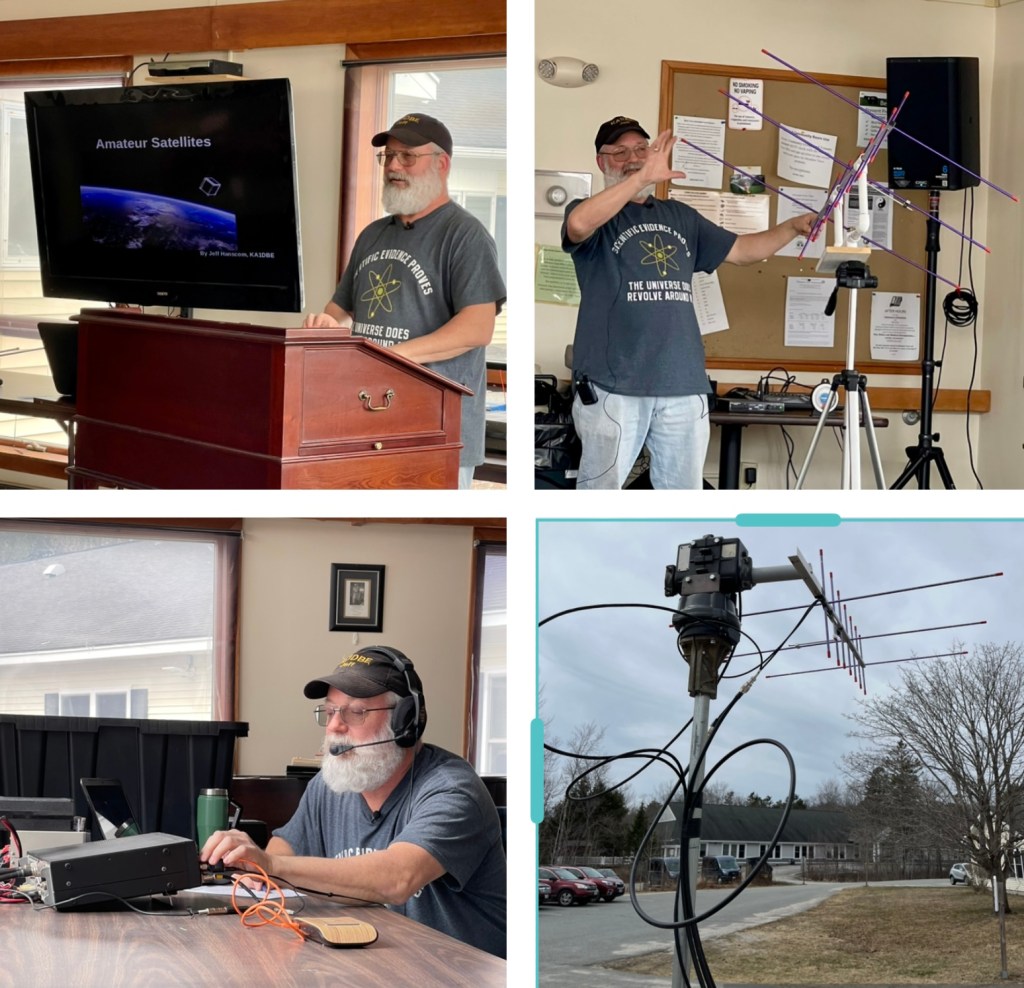
Jeff KA1DBE gave the first presentation on Amateur Satellites. Jeff’s engaging presentation intertwined the history of amateur radio and satellites along with covering the basic items needed. Operating via a satellite is similar to a using a repeater in that the activator sends a message to the satellite, and the satellite then returns the signal to the Earth. There are various configurations of satellites, such as FM satellites that can repeat only one transmission at a time, while linear satellites, which are used with SSB and CW, can handle several transmissions at a time. Jeff covered the information needed to track a satellite across the sky from one horizontal to the other. He reviewed software options along with several radio configurations for managing the transmission, and the types of antenna setups that work well. Satellites are traveling at great speeds, some tumbling as they go, so the antenna needs to be able to adjust quickly to those changes. Jeff also used one of his antennas to track satellite SO124 as it passed over the symposium room. We could hear voices clearly as it passed by. 

Jeff has been hunting satellites for many years, compiling quite a list of contacts.

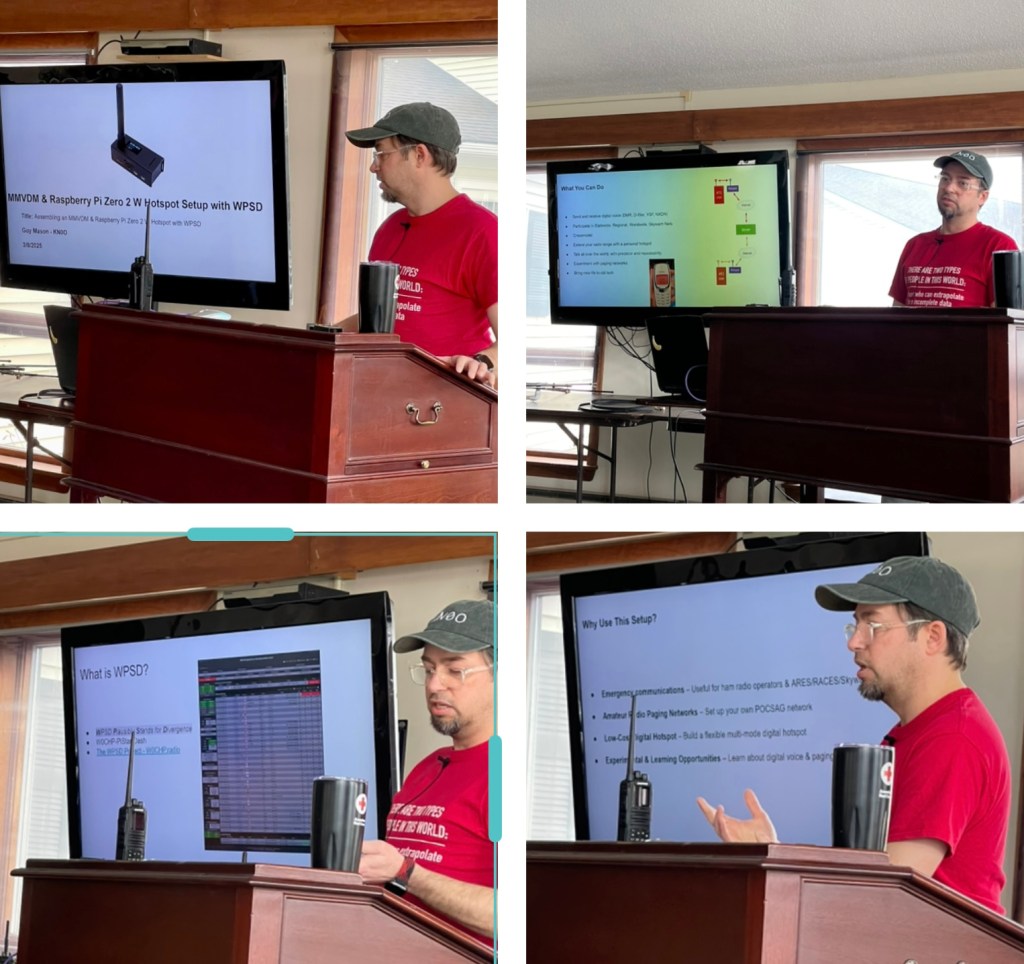
Guy KN0O gave the second presentation on Multi-Mode Digital Voice Modems (MMVDM) & Raspberry Pi Zero 2 W Hotspot Setups with WPSD. Examples of modes handled by a MMDVM include Digital Smart Technologies for Amateur Radio (D-STAR), Digital Mobile Radio (DMR), and Yaesu System Fusion (YSF). Guy gave examples of software uses for this kind of setup, such as sending and receiving digital voice, checking into nets, and extending your radio range. He then gave an informative tutorial on how to set such a system. He covered the required hardware, how to install and configure the WPSD software controls, and how to assemble the Pi Zero 2 W for this purpose. He had the hardware on site to show the details, down to the where to soldier parts together. He also demonstrated the potential for using an old pager as part of this process. He concluded by highlighting the benefits of this system: Emergency Communications, Amateur Radio Paging Networks, and Opportunities to Learn and Experiment. 

Guy’s presentation was packed with information and hardware bits to show and demonstrate.

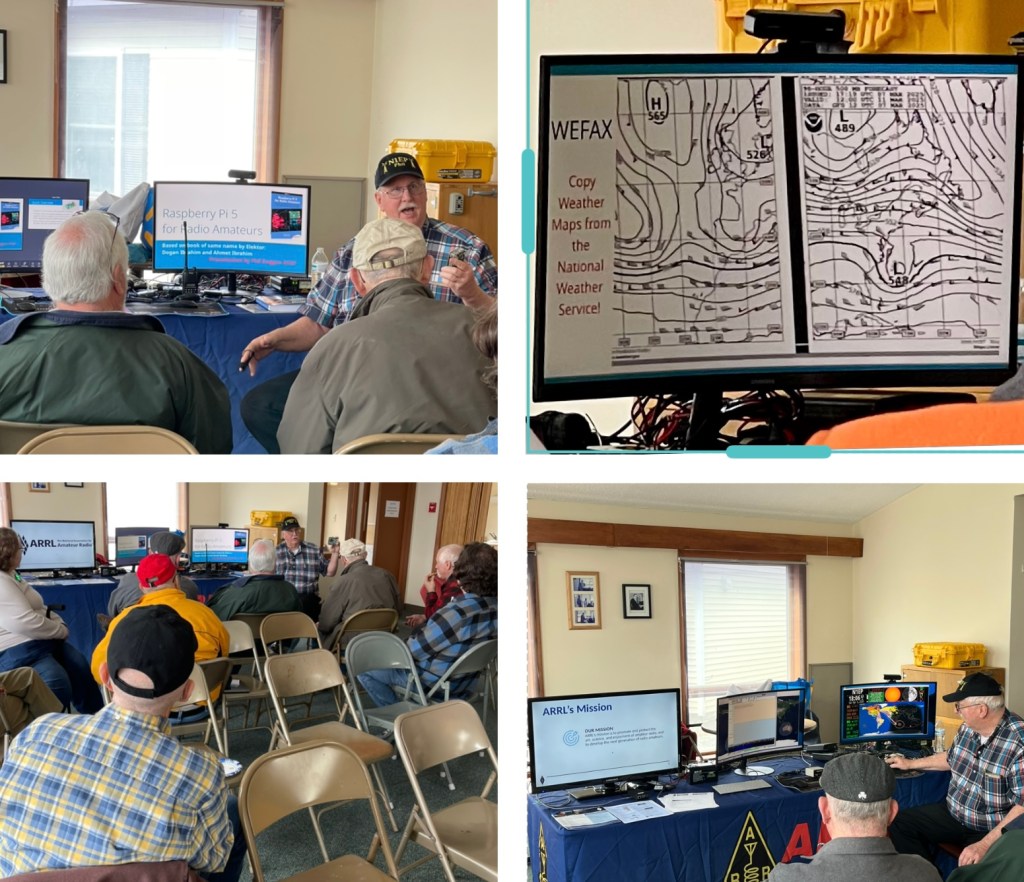
Phil N1EP gave the final presentation on projects and information he found interesting and useful from the book Raspberry Pi 5 for Radio Amateurs, published by Elektor and authored by Dogan Ibrahim and Ahmet Ibrahim. Phil briefly introduced the Raspberry Pi 5, noting its capabilities and uses. He also introduced the book, including its coverage of basic electronics, hardware, and programming, and mentioned some of the many home-brew projects it detailed. For this presentation, Phil focused on ham radio software that can run on a Raspberry Pi 5, specifically when paired with a Software Defined Radio (SDR) dongal, such as listening to FM radio stations, operating WSJT-X, and setting up the Ham Clock display. Embedded in the discussion was also an overview of different types of SDR devices, with pros and cons of each.

Phil’s presentation was a mix of sharing information and inviting audience discussion.

It was a fun-filled and information-filled afternoon! Raffle prizes included an ARRL Operating Manual, an RTL-SDR kit, a Baofeng UV-5RX3, an ARRL gift certificates, and a 50/50 cash prize. Many people deserve a heart-felt “Thank you,” for making this happen. At the risk of missing someone, those folks include: Joan W1DLC, Barbara KC1SSY, & Marion W1GRL for handling the sign-in and raffle tickets, Joan & Barbara for making treats and managing the food and drinks, Phil N1EP for advertising and almost all the items in the room (slide shows, special ARRL displays and literature, raffle prizes), Rob W8HAP for audio equipment and support, and the many people who helped set up the chairs and tables and then return them afterwards. This annual event is always a highlight for EAWA members, friends, and many in the community who join in. We are already looking forward to the 2026 Symposium!
Written by Marion W1GRL

EAWA Lend & Learn Library Returns for March Club Meeting

Let’s try this again. This story was posted for the February club meeting, which was moved to Zoom due to difficult weather conditions. Lend & Learn is on for March! Maybe this will spark you to do a little Spring cleaning?!

Do you have extra amateur radio books or items to lend or give away? For example, we have several hams studying for their next license – are you going to use that old study guide? Perhaps you’ve upgraded some equipment, such as a soldering iron, or purchased the latest version of a book and the earlier edition is just sitting around? Someone who is just starting down that path may appreciate borrowing or taking some of those things that are just taking up extra space on your work bench or book shelf. 

Please bring any items you are willing to loan or give away to the next club meeting, scheduled for Thursday, February 13 at 7:00pm. Exchanges may occur before the meeting, during the break before the program, and after the program. Last August we held the first “EAWA Lend and Learn Library” event with good success! It was fun to see the items people brought and shared. Marion W1GRL borrowed a book on CW from Barbara KC1SSY and found it very helpful.

Each person who is willing to loan out an item is responsible for working out with the recipient how and when the item will be returned. Each person bringing items to give away is responsible for taking home whatever is left of what they brought. 

We are all in this together! Perhaps you have something to share that would make another hams journey a little better.
Written by W1GRL

Passion for Military Radio Support: Barbara KC1SSY & Bill KC2NMK

You can see the joy on their faces and hear the commitment in their voices as Barbara KC1SSY and Bill KC2NMK talk about their respective roles in the Military Auxiliary Radio System (MARS). They volunteer their time, radios, and skills to assist in various operations in the U.S. Air Force and U.S. Coast Guard. MARS includes the U.S. Army, Navy-Marine Corps, Coast Guard, and Air Force.

All of these auxiliary programs play a vital role in supporting military personnel and operations.

Barbara KC1SSY has had some connection to the military for many years. In high school she was in the Civil Air Patrol, later served in the U.S. Air Force for 8 years in the 1990s, and has remained active in veterans organizations. As her interest in amateur radio grew and she gained her licenses, she also began to learn more about the MARS. At the 2024 HamXposition in Marlborough, Massachusetts, she took the opportunity to meet with MARS operators and decided to join.

Barbara uses her equipment at home to execute her responsibilities.

Barbara is in the 1st wing of the U.S. Air Force MARS. The U.S. has 10 wings, with each operating up to two nets a day with digital and voice capabilities.They also engage in numerous preparatory exercises, from the wing to transglobal levels, along with providing services such as HF radio-telephone service for personnel. MARS support reaches to the DOD and the Pentagon by providing communications to airborne assets, message handling and delivery to the National Command Center. As a member of the MARS, Barbara spends approximately 8 to 10 hours a week in training or educational exercises and engagement with weekly nets. It’s clear that the friendships she’s made and the frequent contacts with MARS members brings Barbara much happiness and a sense of purpose.

Barbara KC1SSY is happy to share more information on MARS to anyone interested. Contact her via QRZ or through the “Contact Us” on this webpage.

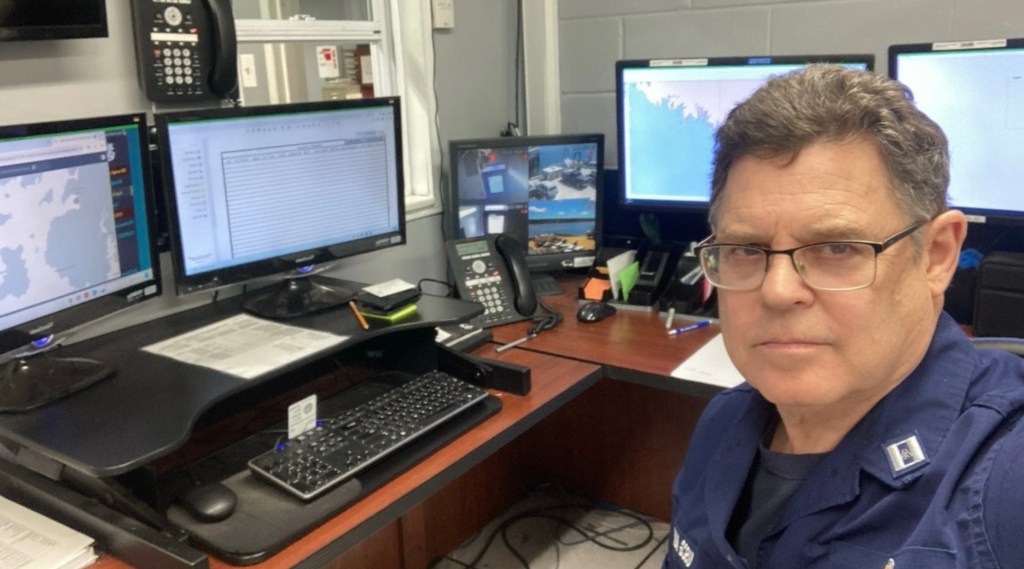
Bill KC2NMK served in the U.S. Navy for 4 years in the 1970s, and then life took him in other directions. He reconnected with the military, specifically, the U.S. Coast Guard, when he relocated in Maine. After some inquiries, he quickly learned that amateur radio operations and being a part of the Coast Guard were good matches for him, and the station in Southwest Harbor, Maine, provided the perfect location. 

Bill volunteers his time primarily at the Coast Guard Station in Southwest Harbor, Maine.

As a part of the U.S. Coast Guard Auxiliary Telecommunication system, Bill engages in many roles, including quality control for weather monitoring. One of his primary roles is to serve as a Watchstander. Along with telecommunications assets, Watchstanders use HF, VHF, and repeater communications to support surface and air missions, including Marine Domain Awareness and joint military operations. Watchstanders participate in preparatory exercises so that during the loss of normal communications they can provide radio-based support for alerting, personnel recall, and the distributions of messages to officers and agencies in need of such information. In addition, participating in regional and district nets is essential. Bill spends approximately 16 hours a week in his auxiliary work, with most of that happening at the coast guard station. During this interview, his biggest smile came as he talked about times he has received a phone call asking if he could come to the station to help out. Similar to Barbara’s account, it’s clear Bill finds much happiness and sense of purpose in his auxiliary role.

Bill KC2NMK is happy to share more information on the Coast Guard Auxiliary to anyone interested. Contact him via QRZ or through the “Contact Us” on this webpage.

Both Barbara KC1SSY and Bill KC2NMK possess a wealth of knowledge and enthusiasm for their respective programs. It’s gratifying to know that, in addition to the many facets of radio operations most of us know, there is a strong, dedicated group working quietly to support our military personnel, exercises and missions.
Written by Marion W1GRL

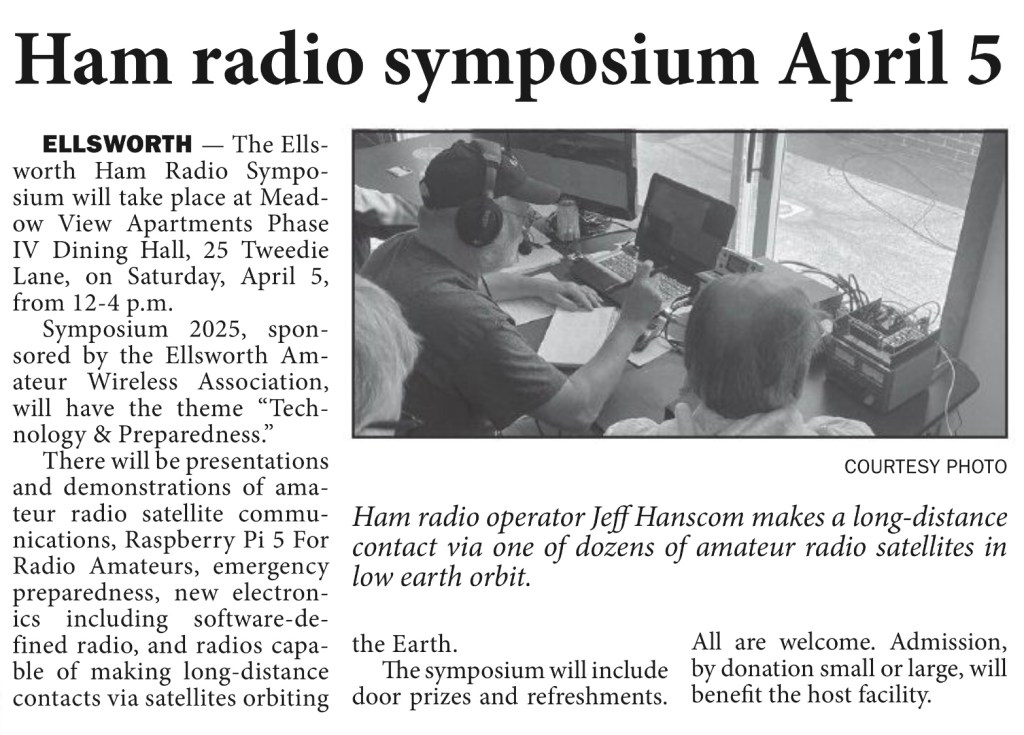
Annual EAWA Ham Radio Symposium is Taking Shape!

Save the date of April 5th for this year’s symposium, “Technology & Preparedness.” There will be presentations and live demonstrations of amateur radio satellite communications, Raspberry Pi 5 For Radio Amateurs, and Emergency Preparedness. Some of the featured cutting-edge technologies include software-defined radio and radios capable of making long-distance contacts via satellites orbiting the Earth. The ‘preparedness’ presentations will include some old and new techniques for dealing with a loss of commercial power, cell phone communications, or internet communications.

Phil N1EP has done a great job in pulling together topics, presenters, and door prizes for this year’s event. He also secured the ARRL designation “ARRL-Sanctioned Operating Specialty Convention” for the event. You may have seen the press releases and stories in the local papers.

All are welcome to attend! The symposium will include door prizes and refreshments. Admission is by donation, which will be forwarded to the host facility. The event will take place on Saturday, April 5, from noon to 4:00pm, at the Meadow View Apartments Phase IV Dining Hall (see map here). 
Article written by Marion W1GRL

Article in the Mt Desert Islander, February 20th, page A6