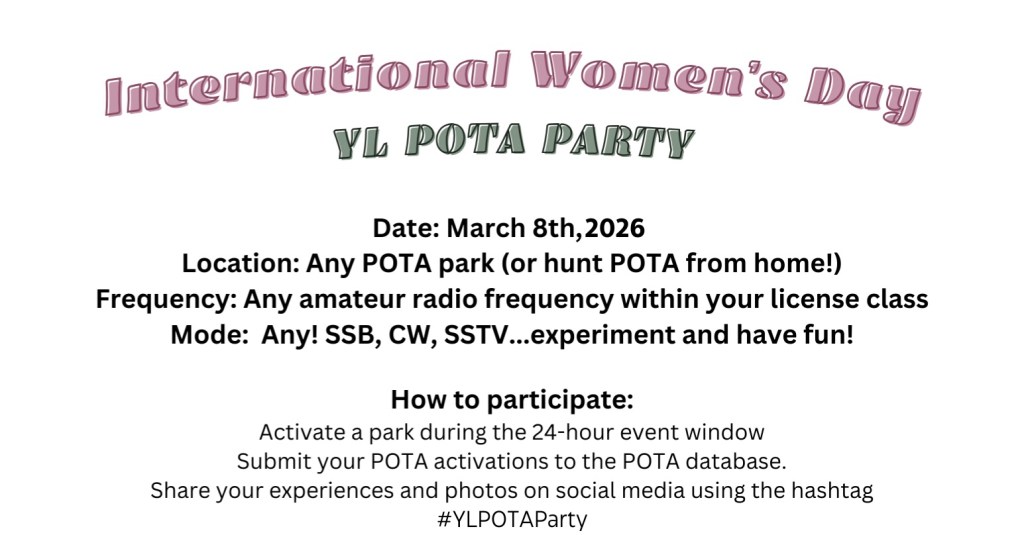
The international ham radio community is coming together in March to celebrate YLs. Many groups around the world are planning YL POTA activations in honor of International Women’s Day. If you’re new to ham radio terms, “YL” comes from Young Lady, which now simply refers to females of any age.
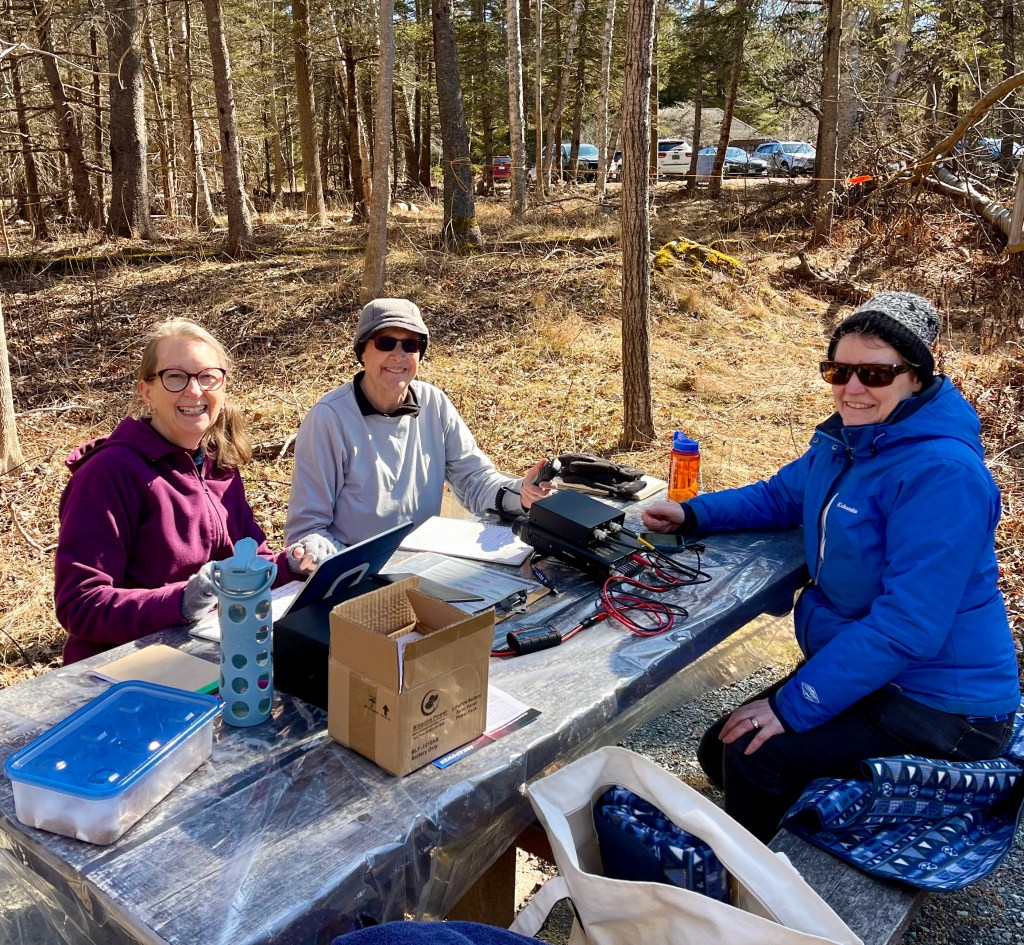
Marion W1GRL, Joan W1DLC, and Barbara KC1SSY, operating on YL POTA Party day in 2024.
The YLs of the EAWA are planning to activate Acadia National Park on Sunday, March 8, from 11:00am to 2:00pm. Joan W1DLC, Barbara KC1SSY, and Marion W1GRL, will be there to greet and share the fun of ham radio. We hope EAWA members and friends will stop by to cheer us on! All women, whether licensed or not, can get on the air if they’d like to.
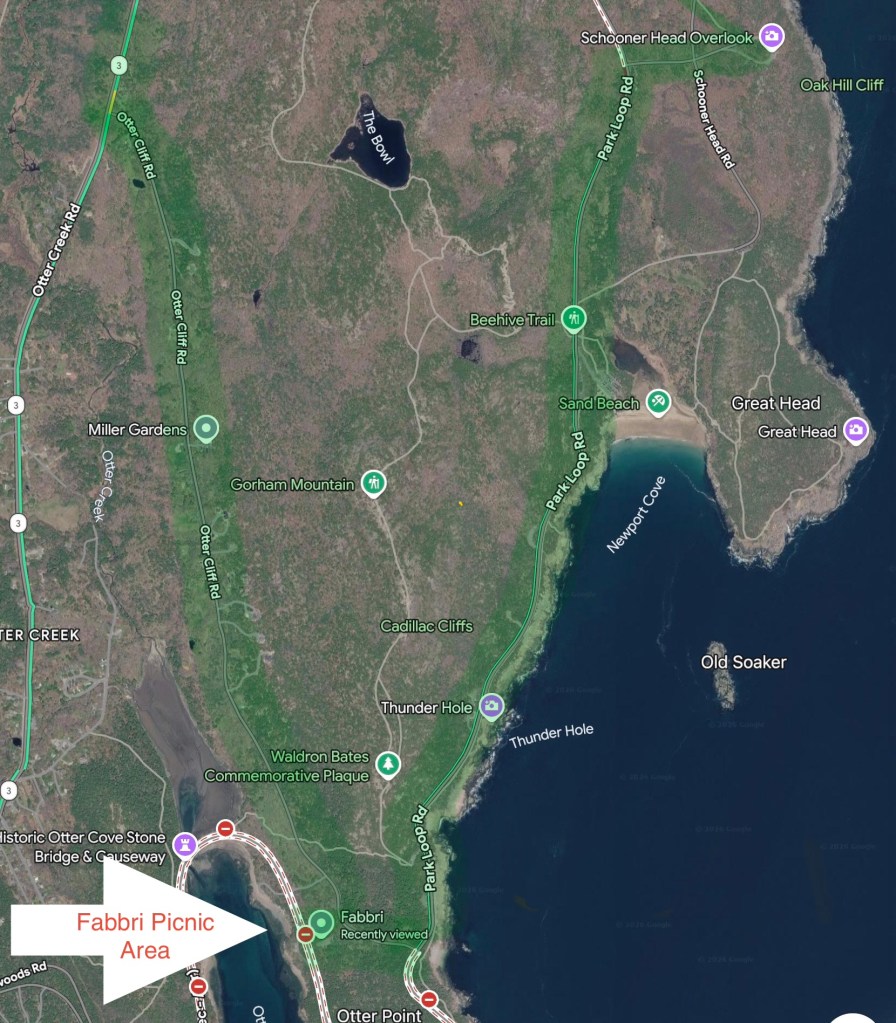
Look for us at a picnic table at Fabbri Picnic Area in Acadia National Park. You can reach Fabbri by turning from Route 3 on the Otter Cliff Road, or by taking Schooner Head Road to the Sand Beach Entrance Station, then following Ocean Drive to the picnic area.
We hope you can join us, but if not, perhaps you can organize a YL POTA Party in your area or hunt YL POTA Parties from home.
It would be so confirming to all the EAWA YL members and friends to have a good turn out! If you have any questions please contact Marion W1GRL (good on QRZ) or use the “Contact Us” form for this website. We hope to see you! Written by Marion W1GRL
Every Wednesday, and twice a month on Sundays, EAWA members and friends gather for ham radio conversations and workshop-style support for kits, home-brew builds, and troubleshooting. Perhaps you will join us sometime?
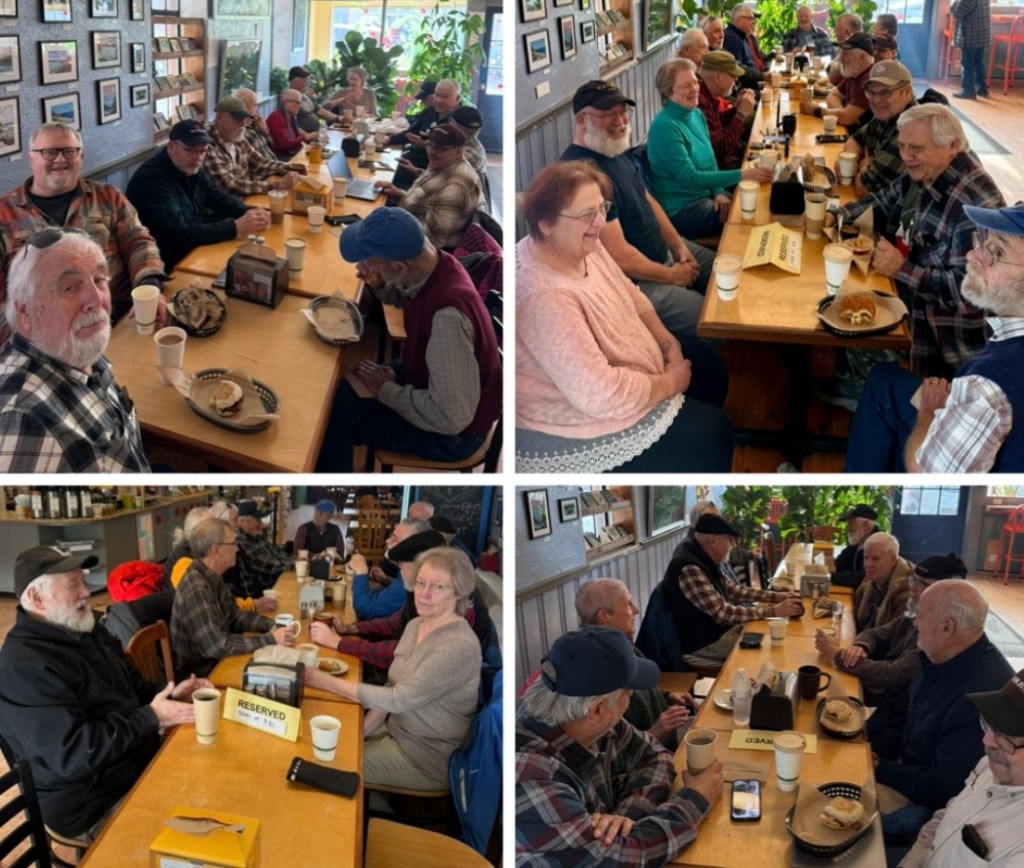
“Clandestine Coffee” provides an easy, enjoyable way to get know ham radio operators in the Downeast area. We usually have 10 to 20 EAWA members and friends around the tables, some coming from as far away as Belfast and Millbridge. Conversations often touch on many radio topics, reflecting the diverse interests of EAWA members.
We meet around 9:30, at Flexit Cafe, 142 Main Street, in downtown Ellsworth. As you walk in, look for the “Reserved” tables to the right.
Like Clandestine Coffee, everyone is welcomed to join in the Weekend Sessions as well. These workshop-style sessions begin at noon at the Meadow View Phase 4 Community Room, 25 Tweedie Lane in Ellsworth (see map here). We regularly have hams come just to hang out and see what everyone else is working on. People often bring in items they are working on, both hardware and software, to share or assemble, and perhaps get advice. Lately there have been soldering activities, assistance with logging programs, and trouble-shooting older equipment.
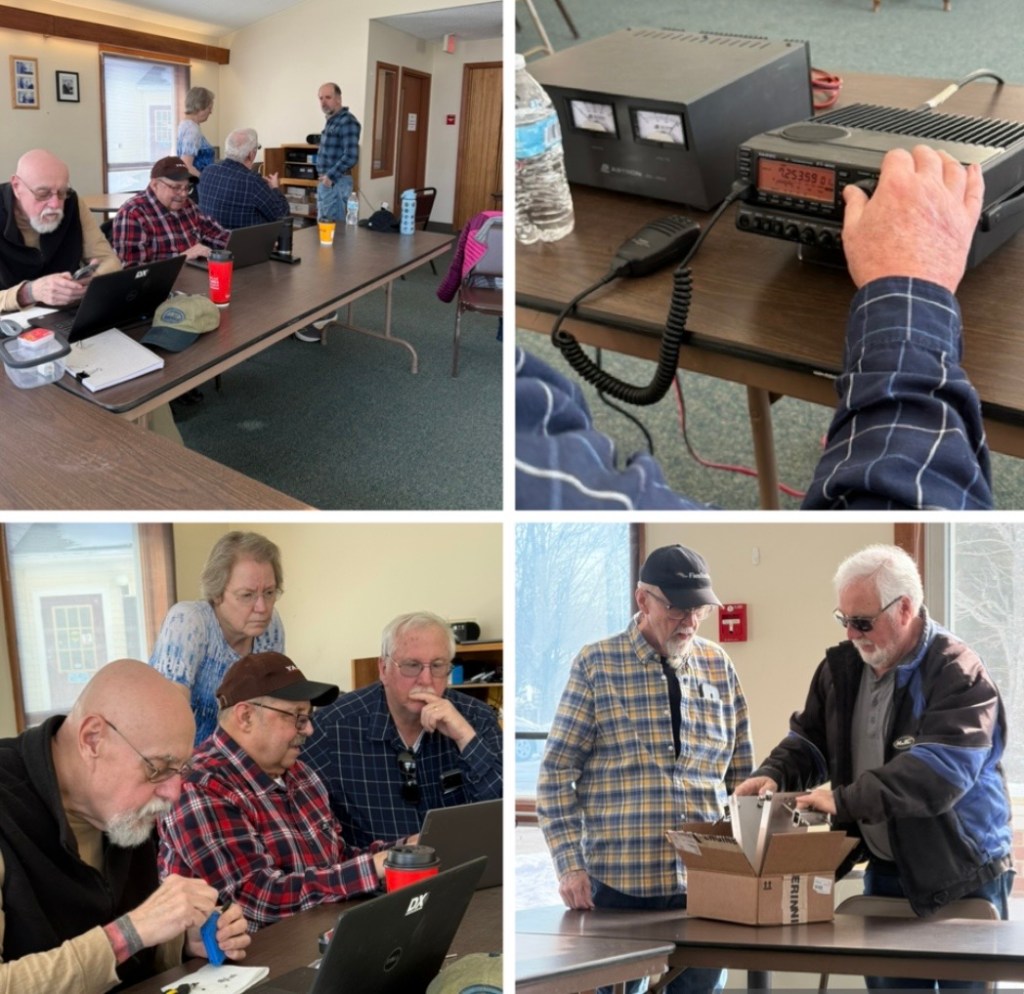
In the top left photo, Dick W1KRP is working on a kit, Mark W1ABY is working on logging, and Phil N1EP, along with Barbara KC1SSY and Tracey AC1UN, are checking out the club station equipment. The top right shows Phil hunting for QSOS. In the lower left, while Dick is working, Mark, Barbara, and Phil are exploring LOTW. The lower right photo shows Stan W1BOY and Mel W1MEB examining an antenna tilt mount.
Unlike Clandestine Coffee, which happens every Wednesday, the Weekend Sessions are held only in the fall and winter months. We have 4 sessions left: March 8 and 22, and April 12 and 26. While you are thinking of what’s on your calendar, make a note that the EAWA’s Annual Ham Radio Symposium, held at the same location, is scheduled for Saturday, April 18. Check this website for more Symposium details as they are announced.
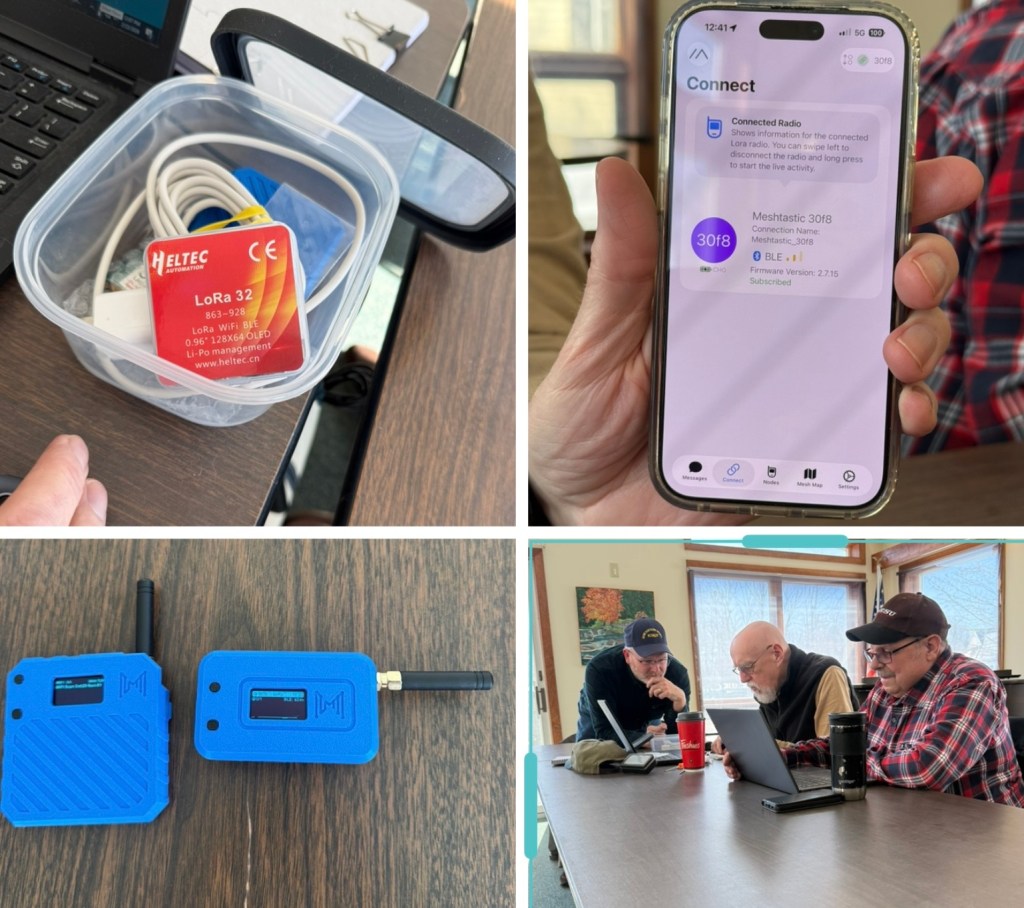
Chris K1WJY and Mark W1ABY, were sharing in Dick’s (W1KRP) build of a Meshtastic node. Dick shared how the Meshtastic network system works, much like texting on a phone.
The EAWA is an active group! Whether you are a member of the club or not, don’t be shy about joining us for any event, or get to know us through our EAWA Facebook group. Amateur radio is an awesome “hobby of a thousand hobbies,” and part of that is joy comes from sharing in a community. We hope to see you soon! Written by Marion W1GRL
The February meeting started as all club meetings do, with introductions and a question: How many America250 W1AW/x stations have you worked so far? Responses ranged from 0 – 7. Following the usual business items, the discussion turned to Winter Field Day. The solar weather disturbances, and cold temperatures and wind at ground level, were real challenges this year. You can read some of the accounts in the story, “Putting the “Winter” in Winter Field Day” here.
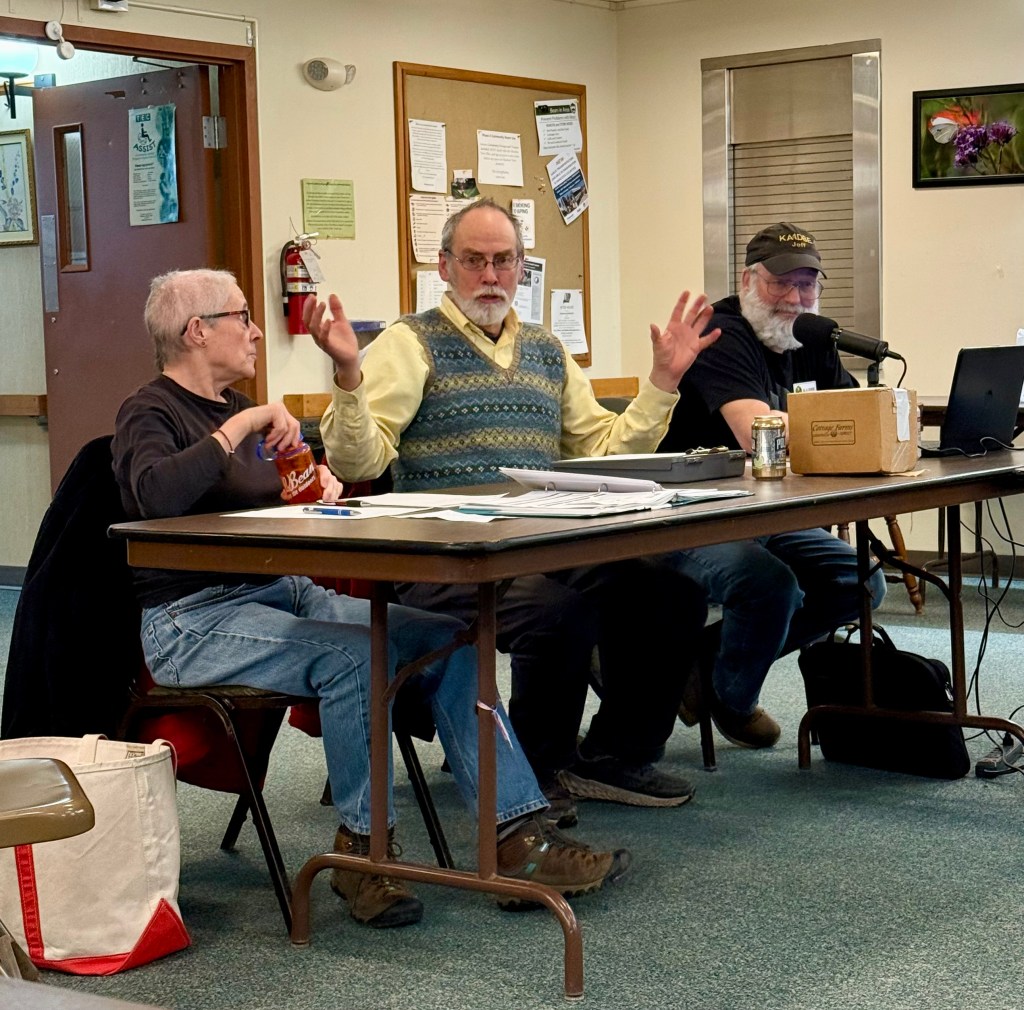
Joan W1DLC, Secretary/Treasurer, John KQ1P, President, and Jeff KA1DBE, Symposium Chair, brought the meeting to order. The Vice President, Marion W1GRL is behind the camera.
A second major topic of discussion was the upcoming Annual Ham Radio Symposium scheduled for April 18, noon to 4pm, at Meadow View Apartments (see map here). This year the focus is on cutting edge tools and tech for ham radio. The agenda is taking shape in terms of speakers and hands-on demonstrations. Light snacks will be provided. Help is welcomed to assist in the set-up and the clean-up of the event. More details will be provided at the March club meeting. For readers who have never attended the annual symposium, browsing the story of last year’s event will offer some insights (read story here). If you have questions or suggestions, please contact Jeff KA1DBE (good on QRZ or use the Contact Us feature of this website).
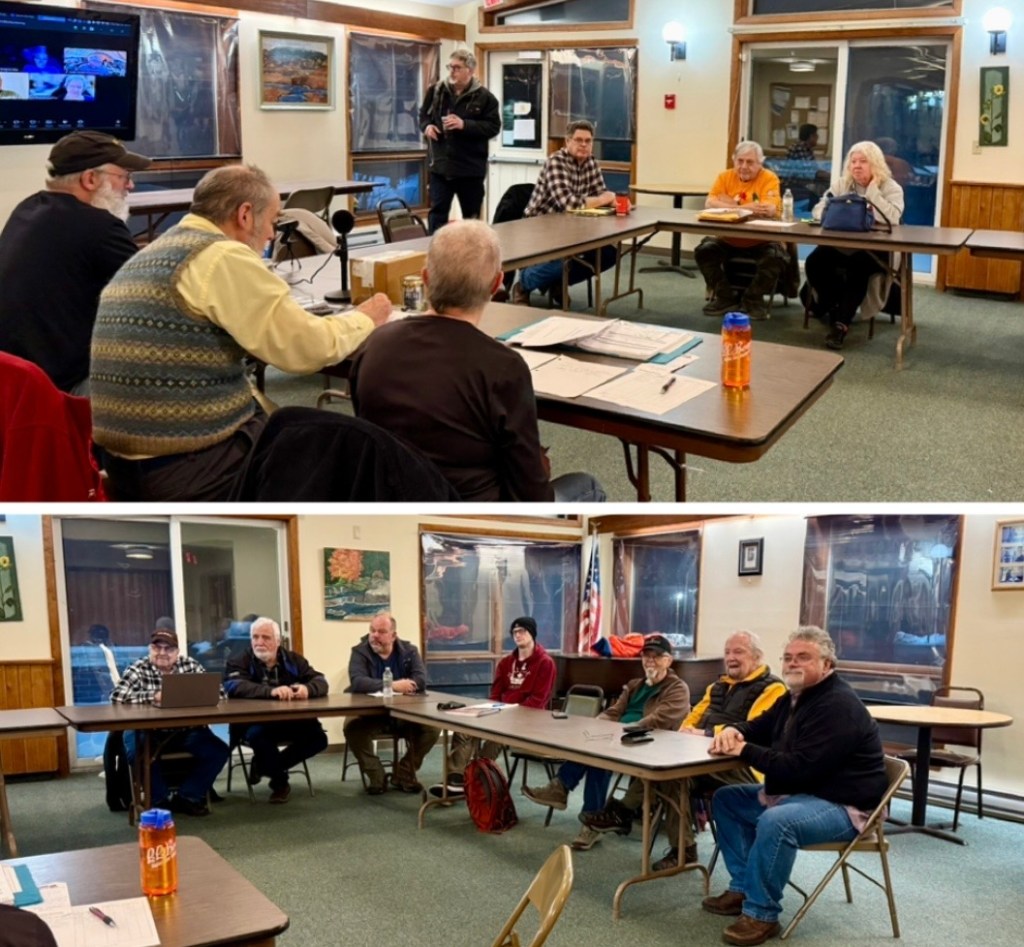
Even though we were missing several regulars who were under the weather, the meeting was well attended! In the top photo, circling to the left, is Joan W1DLC, John KQ1P, Jeff KA1DBE, Markus K1FIG, Bill KC2NMK, Matt KC1VLH, and Matt’s wife Susan. In the lower photo, starting at the left, Mark W1ABY, Mel W1MEB, Tony W1TRG, Elias WF1WAG, Stan W1BOY, Rob W8HAP, and Gerry W1VE.
The final major topic of the evening focused on recruiting EAWA members and friends to participate in the Emergency Communications for the Sea of Blue Autism Awareness Walk/5K/10K, to be held Saturday, April 25. The club provided similar services last year, which was the the first partnering of the EAWA and the Sea of Blue. You can read about last year’s event, “Teaming Up for Success” here. This year’s needs are the same: approximately 15 radio operators (we can use more!) working in pairs along the route and managing net controls in the communications trailer. Hams will meet around 7:30am for an organizational meeting (with coffee and treats!), confirm location assignments, and comms checks. The official activities start at 9:30am. EAWA members and friends are encouraged to participate in any of the silent auctions or other festivities and to partake of the wonderful lunch snacks and treats.
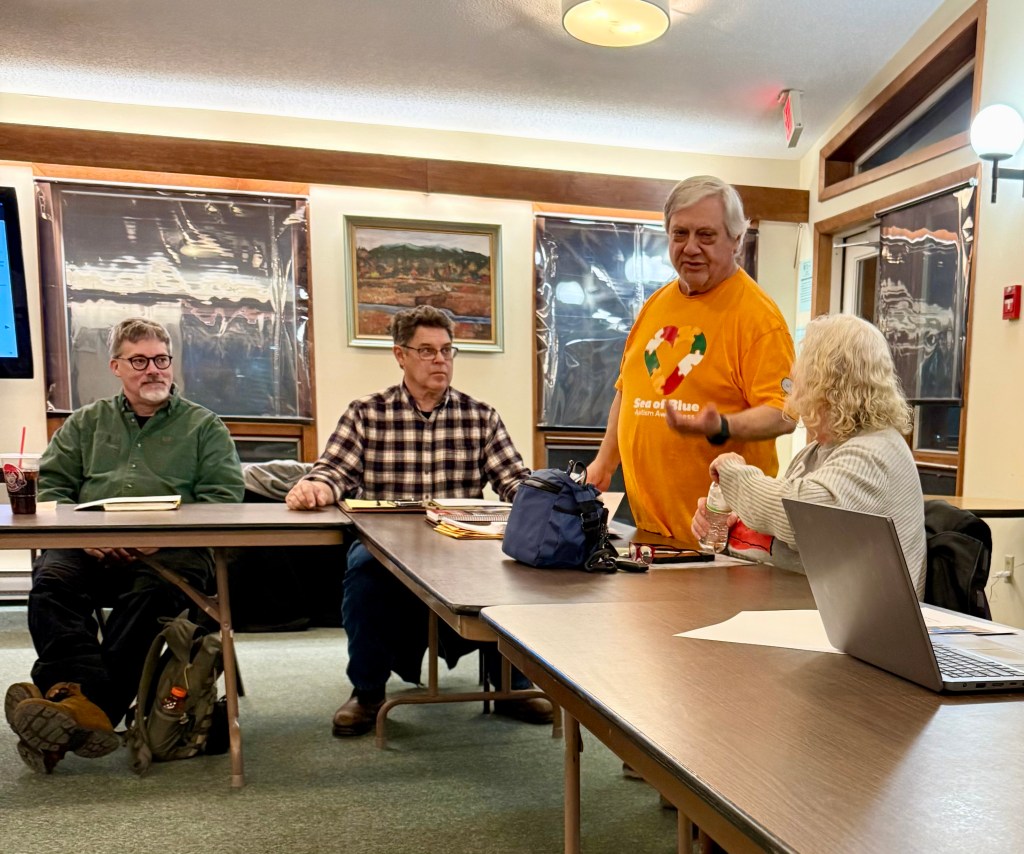
Matt KC1VLH, a Director of the Sea of Blue event, shared the details of this year’s race.
Check this website for more information on the items mentioned above, and other upcoming events such as the YL POTA planned for March 8, International Women’s Day. The EAWA always has something to look forward to! Written by Marion W1GRL
With two large RTTY contests on the horizon, this is a good time to consider adding RTTY to your ham radio experience. If you are a RTTY operator, this a friendly reminder that the CQ World Wide RTTY WPX happens the weekend of February 14th, and the North American QSO Party RTTY is scheduled for Saturday February 28th. Unlike Phone or CW, it can be difficult to find a RTTY station to work outside of a contest. RTTY contesting is similar to other modes in that some hams enjoy the speed of running a frequency while others prefer the more causal pace of search and pounce.
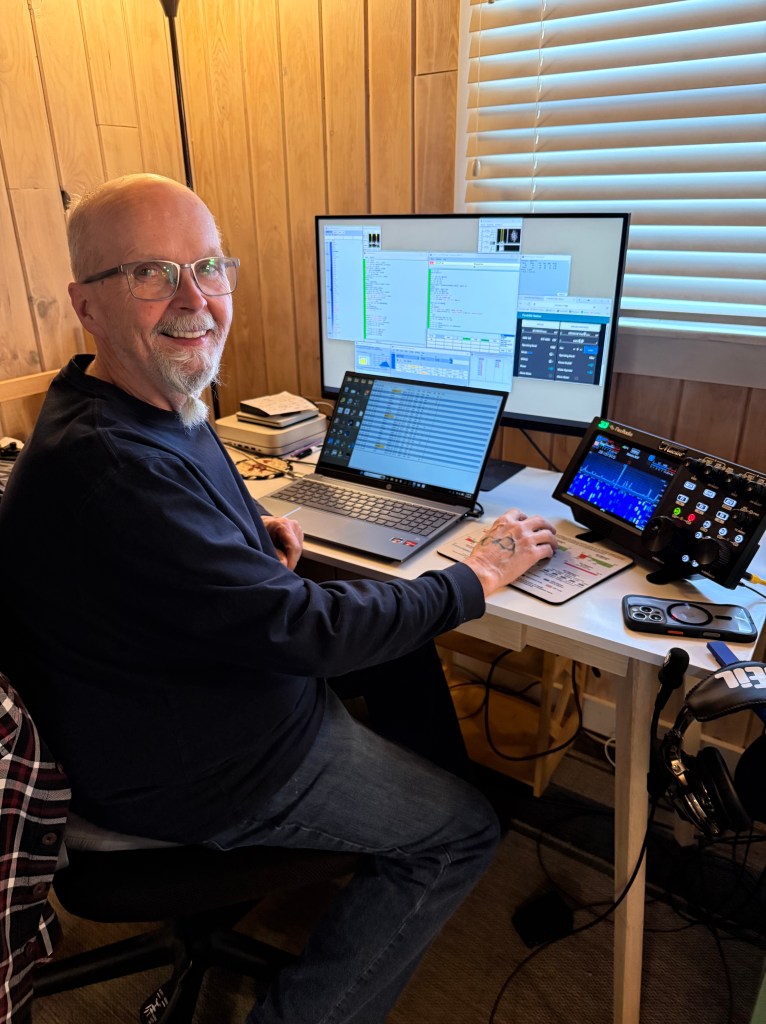
Stan paused for a moment while working the recent ARRL RTTY Round-Up.
Radio Teletype, abbreviated RTTY, refers to the use of a radio and modem connected to a basic teleprinter. Some call it the “original keyboard to keyboard mode.” Amateur radio use of RTTY became popular as the first generations of commercial teleprinters were being retired. As technology developed, the physical teleprinters were replaced with computers making the mode much more accessible. RTTY is a digital mode, often grouped along with FT8, JS8Call, and PSK31 in contests. RTTY uses Frequency Shift Keying (FSK) or Audio Frequency Shift Keying (AFSK) to transmit data at a standard 45.45 baud rate. It is less automated than FT8 and requires operator skill in tuning.
It’s often said that if your radio is configured for FT8, you can easily setup for RTTY with the addition of some software. Stan W1BOY put that claim to the test, and found RTTY contesting to be compelling and fun! His first RTTY contest experience was the Worked All Europe DX RTTY contest in November 2024. He was hooked and worked all of the major and many of the smaller RTTY contests in 2025. In fact, he has more RTTY contacts in his log for 2025 than any of the other mode and he’s looking forward to a better year in 2026!
RTTY is a relatively recent addition to Stan’s radio journey. His interest began when as a schoolboy he heard his principal taking about amateur radio. After being licensed in his early 20s, he was been active off and on as life got busy. Once retired and had more time, he focused mostly on station building and home-brew radios. When his wife, Marion W1GRL, decided to get active in the hobby, Stan started spending more time operating. RTTY suddenly became more attractive as a way to be in a contest, flex his technical muscles, and celebrate a traditional HF mode.
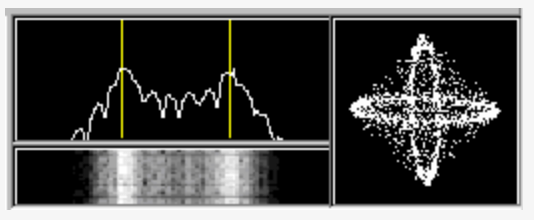
Typical tuning indicators in RTTY software
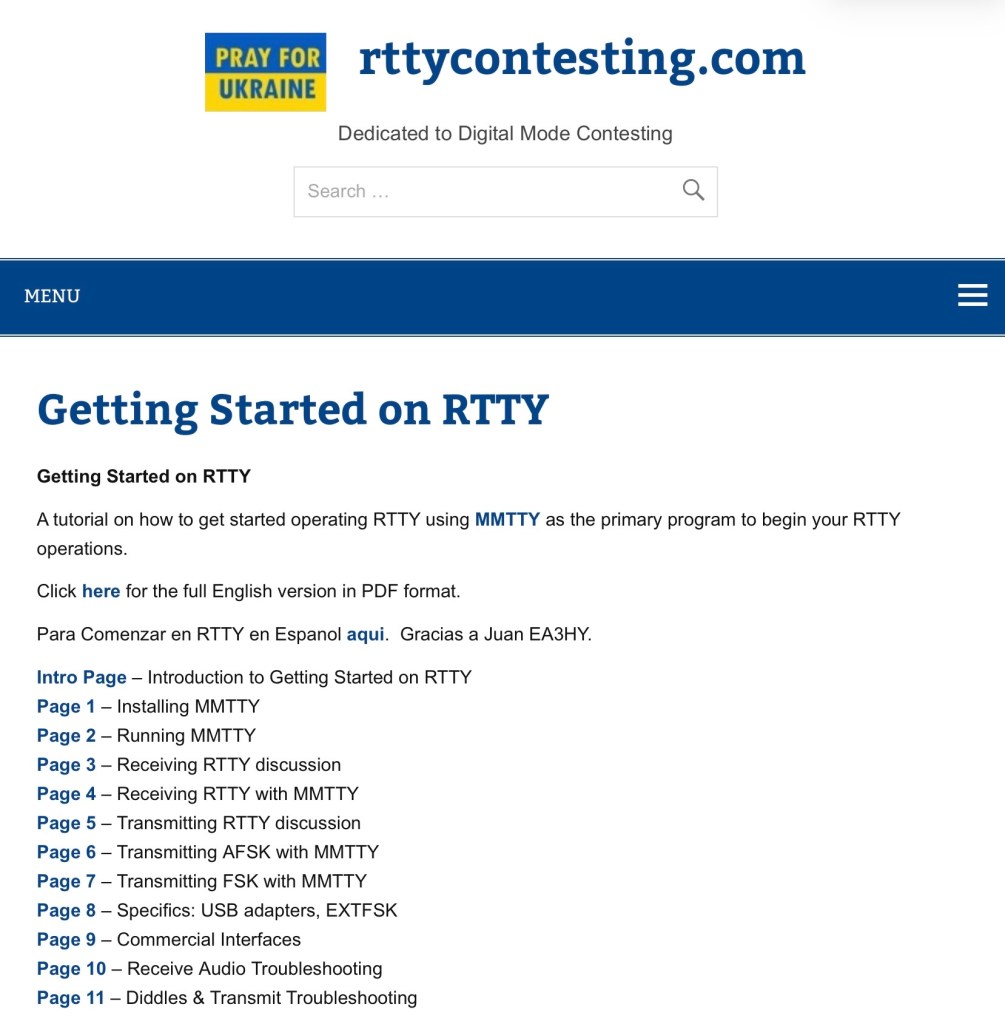
Tuning RTTY signals involves aligning the transceiver’s frequency so that two FSK or AFSK signals, comprised of ‘mark’ and ‘space,’ properly fit within the receiver’s passband. Typically, software tools such as MMTTY or 2Tone are used to match signal peaks on a waterfall or an X-Y display. Often operators will have two programs individually working to decode signals, watching to see which program is doing the best at the moment to pull out the accurate call sign or exchange. As mentioned above, if you’ve setup your radio for FT8, half of the work is done. Setting up RTTY involves using CAT to control your radio and using a modem to send and receive audio to and from the radio. For help with RTTY software and just learning more about the mode, Stan recommends https://www.rttycontesting.com/rtty/.
In addition to a “Getting Started on RTTY” section, you can find specific instructions for setting up software.
One of the best things about the ham radio hobby is that if you find the type of operating you really enjoy, then you can settle in and have fun! And if you are ready for a new challenge or just something different, there’s lots to choose from! RTTY provides a way to celebrate a long-standing amateur radio mode and enjoy either casual or serious contesting. Maybe you can give it a try in the upcoming contests. Written by Marion. W1GRL
Over the weekend of January 24th and 25th, EAWA members and friends participated in Winter Field Day in a variety of ways. Some went “all out” with their off-grid wilderness set-up, while others stayed closer to home. Although Winter Field Day (WFD) has much in common with the ARRL Field Day in June, the focus and point system is aimed at true field operations. The WFD website states the event, “aims to help participants improve their preparedness for disasters and enhance their operational abilities in adverse conditions.” With temperatures below zero, made worse by winds, and heavy snowfall directly following the event, coastal Mainers nailed the “adverse conditions”!
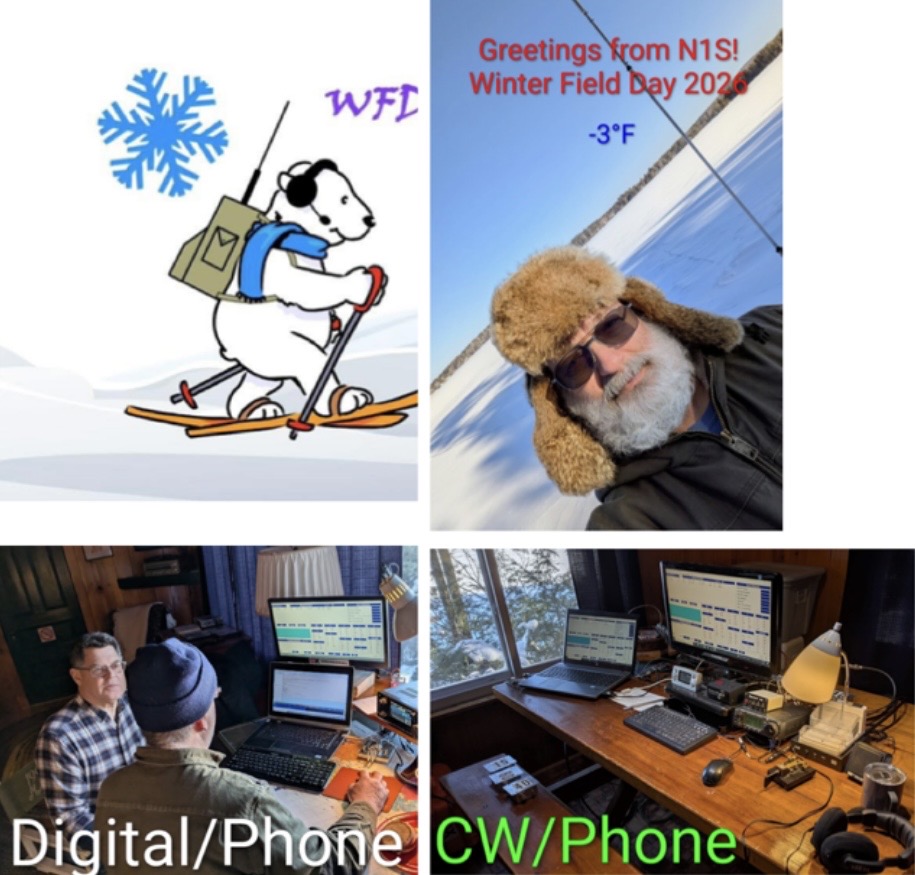
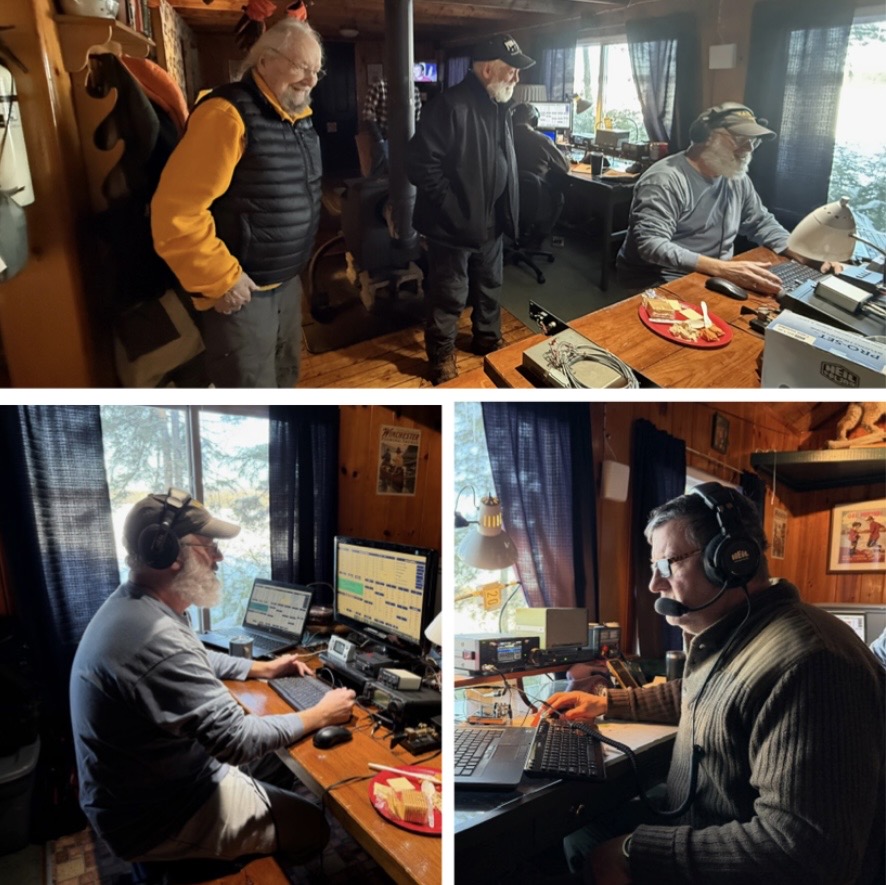
The N1S (North Star) station has been operating WFD for several years. In the top right is Jeff KA1DBE, and the bottom left shows Bill KC2NMK and Matt W1MRH.
Matt W1MRH and Jeff KA1DBE set up their special events station N1S at Matt’s lakeside camp. Bill KC2NMK joined the team this year. They were ready to go an hour before WFD started, and worked the allowed 24 out of 30 hours. The bands were noisy, and around midnight 40 meters was the only band open. Two hours into the event they realize they were using two different versions of N3FJP. Thankfully, the mix-up turned out to be a non-issue. Bill operated PSK while Matt and Jeff worked SSB, CW, WinLink, satellites. The team also copied the WFD bulletin.
This year N1S had visits from Rob W8HAP and Sean KC1SSW (pictured above), along with Bob AB1EP, and a non-ham friend of Jeff’s who wanted to check out the station.
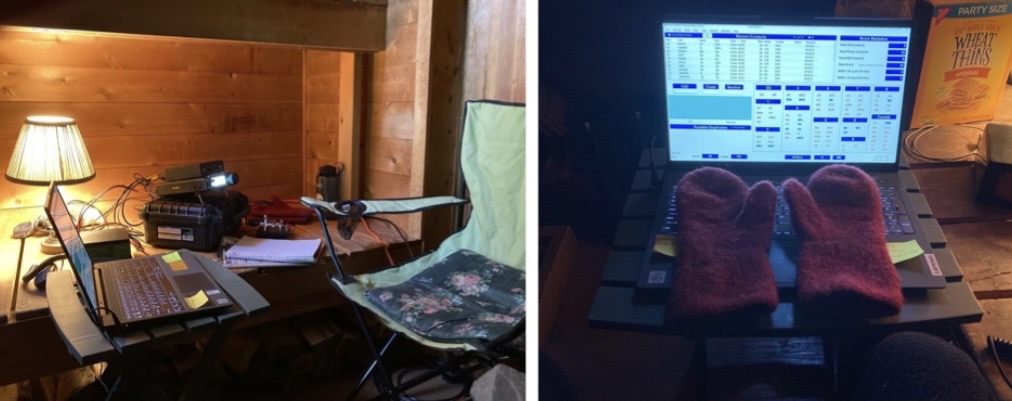
Joan W1DLC chose to set up an off-grid station near her home. In a small out-building she setup her gear, along with a wood stove. Although she added some insulation, the cold temperatures and wind were too much for the small stove. She worked for 6 hours, with both SSB and CW, before shutting down.
Joan’s station – close to home but still off-grid.
Matt KC1VLH operated inside his home but used only emergency power for his radio and computer. He used a battery box he build for POTA to power his equipment. Matt operated for 16 hours, making many SSB contacts. This was Matt’s first WFD activation.
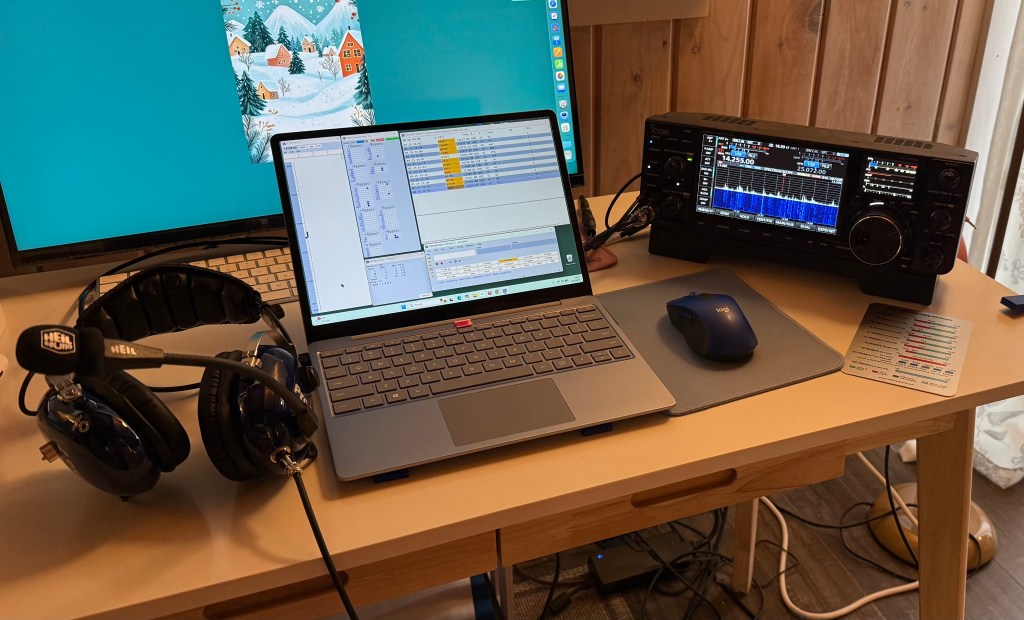
Marion W1GRL choose the easiest way to participate, hunting stations from home.
Most likely there were others operating WFD as well. One of the best things about ham radio is the many ways we can engage the hobby. It’s wonderful to have a community that offers so many ways to participate and enjoy radio communications. Cheers to Winter Field Day! Perhaps next year it will coincide with a January thaw? Perhaps not. Whatever the conditions, EAWA members and friends will be up for the challenge. Written by Marion W1GRL

 W1TU
W1TU 