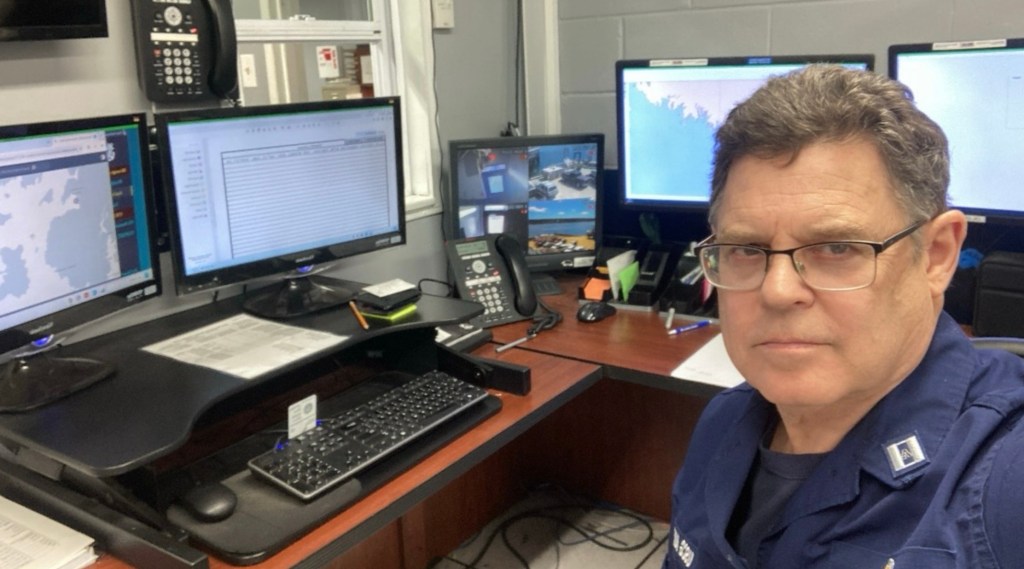
Ham Radio Symposium: Technology Enhancing the Power of Radio

The annual Ham Radio Symposium, sponsored by the EAWA, was held on Saturday, April 5. In addition to the three speakers, there were several antennas to view, free pamphlets, and rotating slide shows to browse. There were also chances to win several raffle prizes and some home-made treats to enjoy. The Symposium began with words of welcome from Phil N1EP, the Maine ARRL Section Manager, and John KQ1P, the President of the Ellsworth Amateur Wireless Association.

Sincere welcomes from the Maine ARRL Section Manager, the President of the Ellsworth Amateur Wireless Association, and the Women Radio Operators of Maine.

Jeff KA1DBE gave the first presentation on Amateur Satellites. Jeff’s engaging presentation intertwined the history of amateur radio and satellites along with covering the basic items needed. Operating via a satellite is similar to a using a repeater in that the activator sends a message to the satellite, and the satellite then returns the signal to the Earth. There are various configurations of satellites, such as FM satellites that can repeat only one transmission at a time, while linear satellites, which are used with SSB and CW, can handle several transmissions at a time. Jeff covered the information needed to track a satellite across the sky from one horizontal to the other. He reviewed software options along with several radio configurations for managing the transmission, and the types of antenna setups that work well. Satellites are traveling at great speeds, some tumbling as they go, so the antenna needs to be able to adjust quickly to those changes. Jeff also used one of his antennas to track satellite SO124 as it passed over the symposium room. We could hear voices clearly as it passed by. 
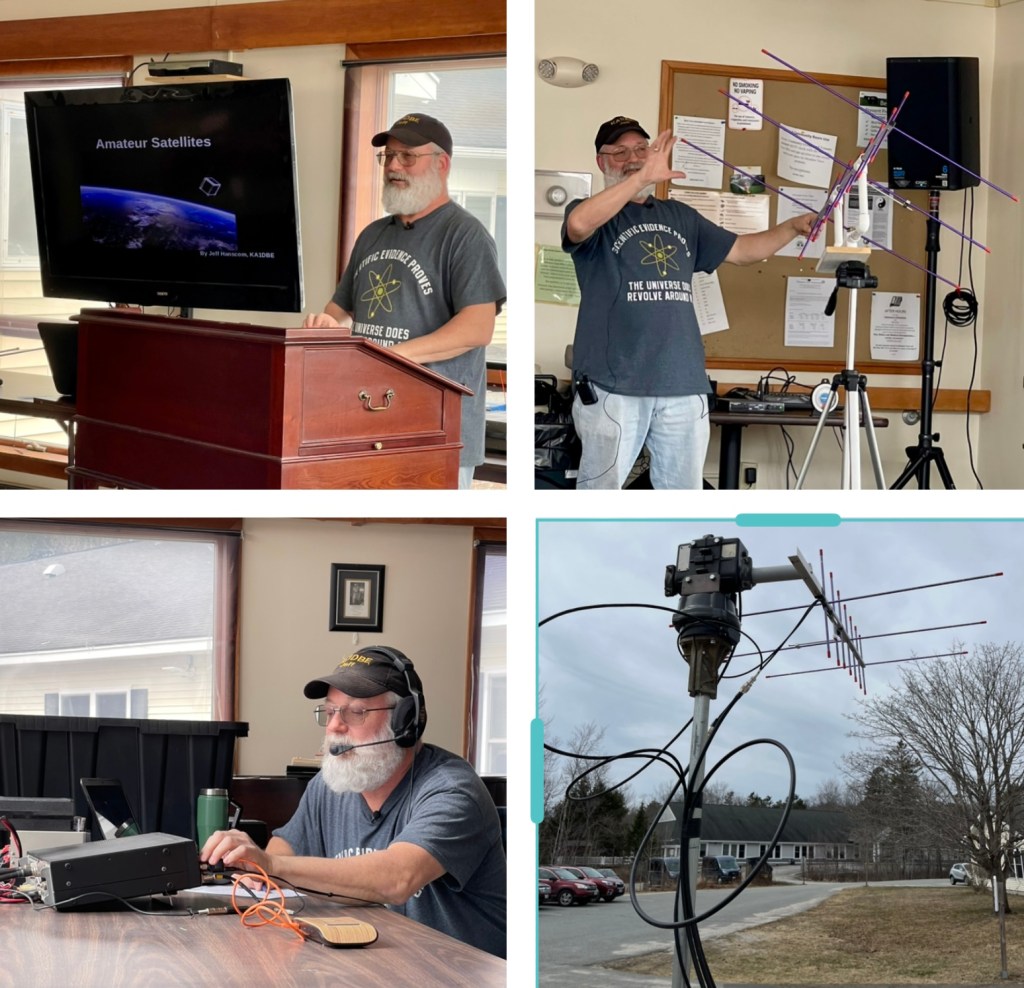
Jeff has been hunting satellites for many years, compiling quite a list of contacts.

Guy KN0O gave the second presentation on Multi-Mode Digital Voice Modems (MMVDM) & Raspberry Pi Zero 2 W Hotspot Setups with WPSD. Examples of modes handled by a MMDVM include Digital Smart Technologies for Amateur Radio (D-STAR), Digital Mobile Radio (DMR), and Yaesu System Fusion (YSF). Guy gave examples of software uses for this kind of setup, such as sending and receiving digital voice, checking into nets, and extending your radio range. He then gave an informative tutorial on how to set such a system. He covered the required hardware, how to install and configure the WPSD software controls, and how to assemble the Pi Zero 2 W for this purpose. He had the hardware on site to show the details, down to the where to soldier parts together. He also demonstrated the potential for using an old pager as part of this process. He concluded by highlighting the benefits of this system: Emergency Communications, Amateur Radio Paging Networks, and Opportunities to Learn and Experiment. 
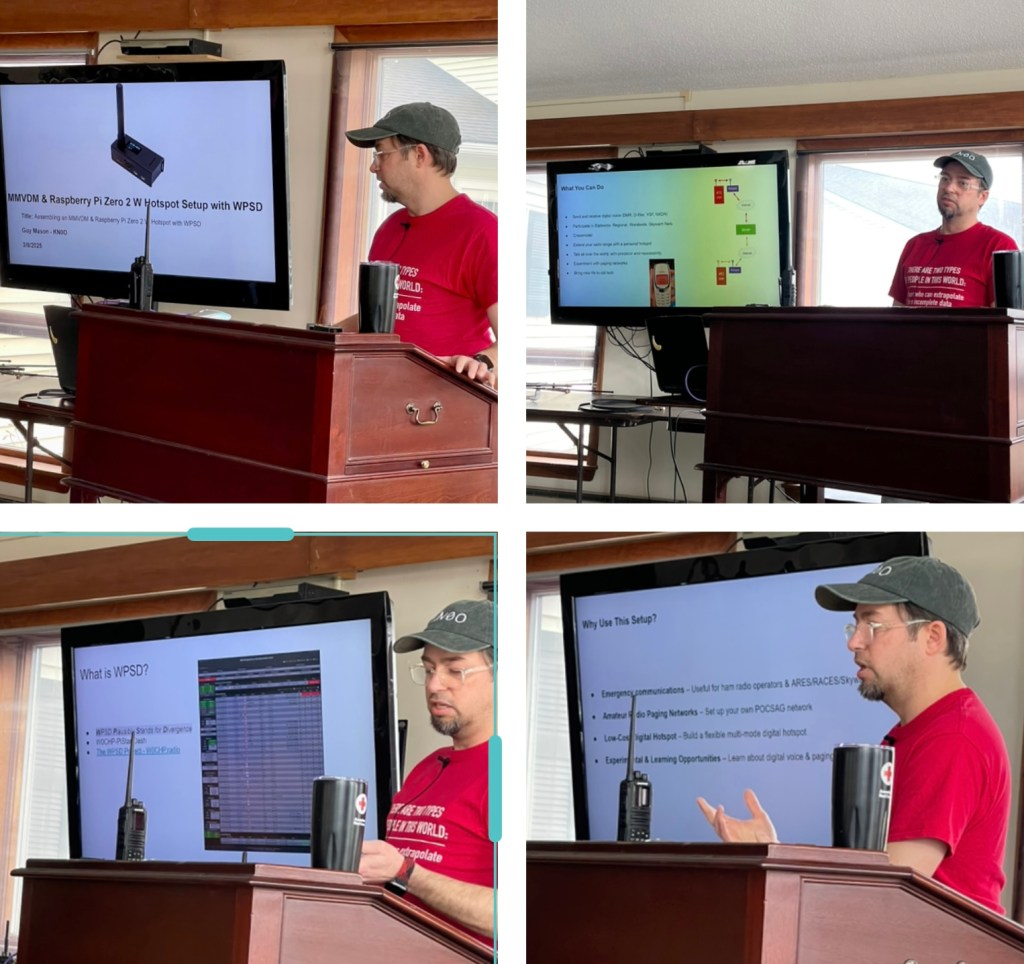
Guy’s presentation was packed with information and hardware bits to show and demonstrate.

Phil N1EP gave the final presentation on projects and information he found interesting and useful from the book Raspberry Pi 5 for Radio Amateurs, published by Elektor and authored by Dogan Ibrahim and Ahmet Ibrahim. Phil briefly introduced the Raspberry Pi 5, noting its capabilities and uses. He also introduced the book, including its coverage of basic electronics, hardware, and programming, and mentioned some of the many home-brew projects it detailed. For this presentation, Phil focused on ham radio software that can run on a Raspberry Pi 5, specifically when paired with a Software Defined Radio (SDR) dongal, such as listening to FM radio stations, operating WSJT-X, and setting up the Ham Clock display. Embedded in the discussion was also an overview of different types of SDR devices, with pros and cons of each.
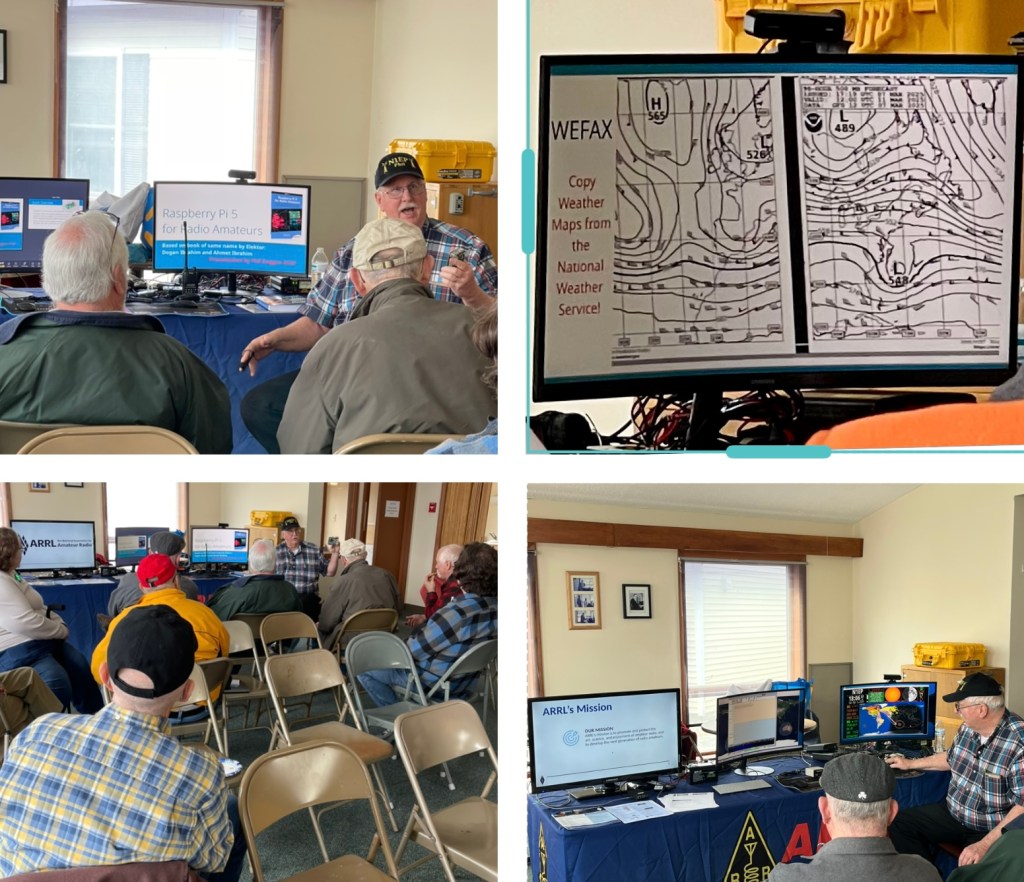
Phil’s presentation was a mix of sharing information and inviting audience discussion.

It was a fun-filled and information-filled afternoon! Raffle prizes included an ARRL Operating Manual, an RTL-SDR kit, a Baofeng UV-5RX3, an ARRL gift certificates, and a 50/50 cash prize. Many people deserve a heart-felt “Thank you,” for making this happen. At the risk of missing someone, those folks include: Joan W1DLC, Barbara KC1SSY, & Marion W1GRL for handling the sign-in and raffle tickets, Joan & Barbara for making treats and managing the food and drinks, Phil N1EP for advertising and almost all the items in the room (slide shows, special ARRL displays and literature, raffle prizes), Rob W8HAP for audio equipment and support, and the many people who helped set up the chairs and tables and then return them afterwards. This annual event is always a highlight for EAWA members, friends, and many in the community who join in. We are already looking forward to the 2026 Symposium!
Written by Marion W1GRL
Weekend Session on a Spring Day

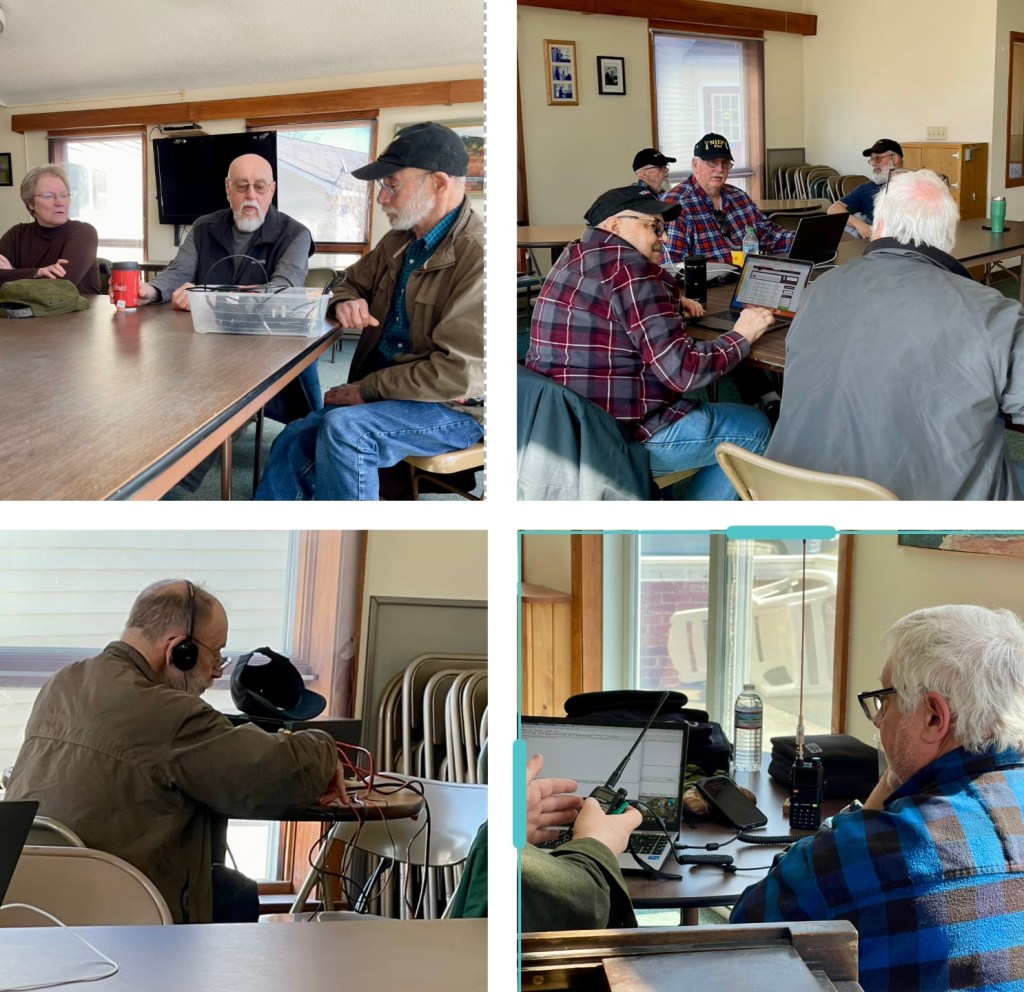
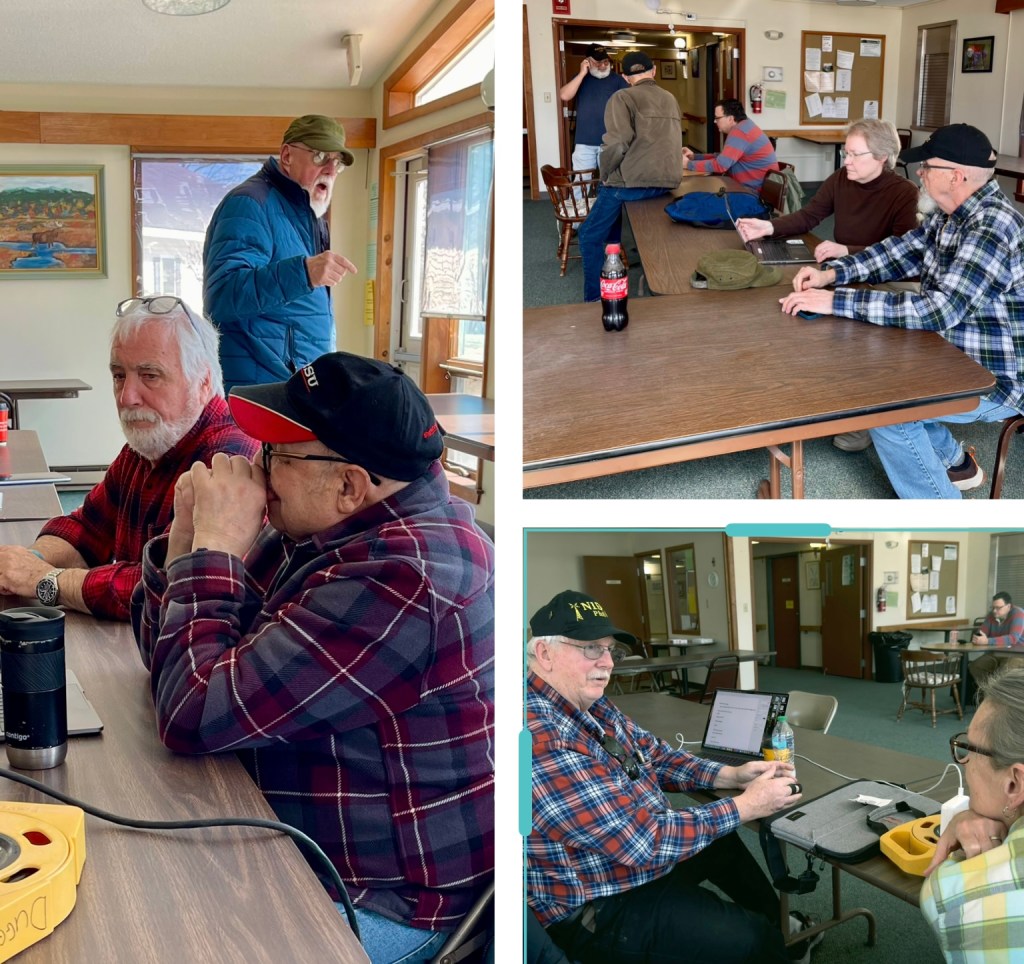
As the season for Weekend Sessions winds down, EAWA members and friends gathered to work on items and share radio stories from the week. At the previous Weekend Session we had a new ham join us, and this week we had a returning ham join us.

Lots of sharing and mentoring happening here!

Among the conversations heard this week were:
Congratulating Jeff on his completion of 5 band DXCC
Contacting DX, including Kuwait and Nepal
Hunting POTA activators
Exploring local Packet radio network
Creating filters for QRZ logbook entries
Plotting contacts on a map using Grid Tracker
Trying a QRP CW rig on the club’s HF antenna

It’s not all talk — lots of listening happening too!

As mentioned, the calendar of events is shifting to the summer schedule. Coming soon we have the annual Ham Radio Symposium on Saturday, April 5th, noon to 4:00, and the last Weekend Session scheduled for April 19th. Weekend sessions will start back up in the fall.
Written by Marion W1GRL

March Club Mtg: Lots to Learn!

The March meeting started with introductions and the question, “Do you use any digital modes?” The question brought many laughs, and responses from “all the time” to “only as a last resort” to a tongue-in-cheek “never heard of it.” The meeting was packed with information. Among the highlights was further discussion of the Emergency Communications plan for the Sea of Blue Autism Awareness Walk & Run, scheduled for Saturday, April 26, in Northeast Harbor. There are slots for more operators if you would like to volunteer. Contact Barbara KC1SSY via QRZ or the Contact Us on this webpage.

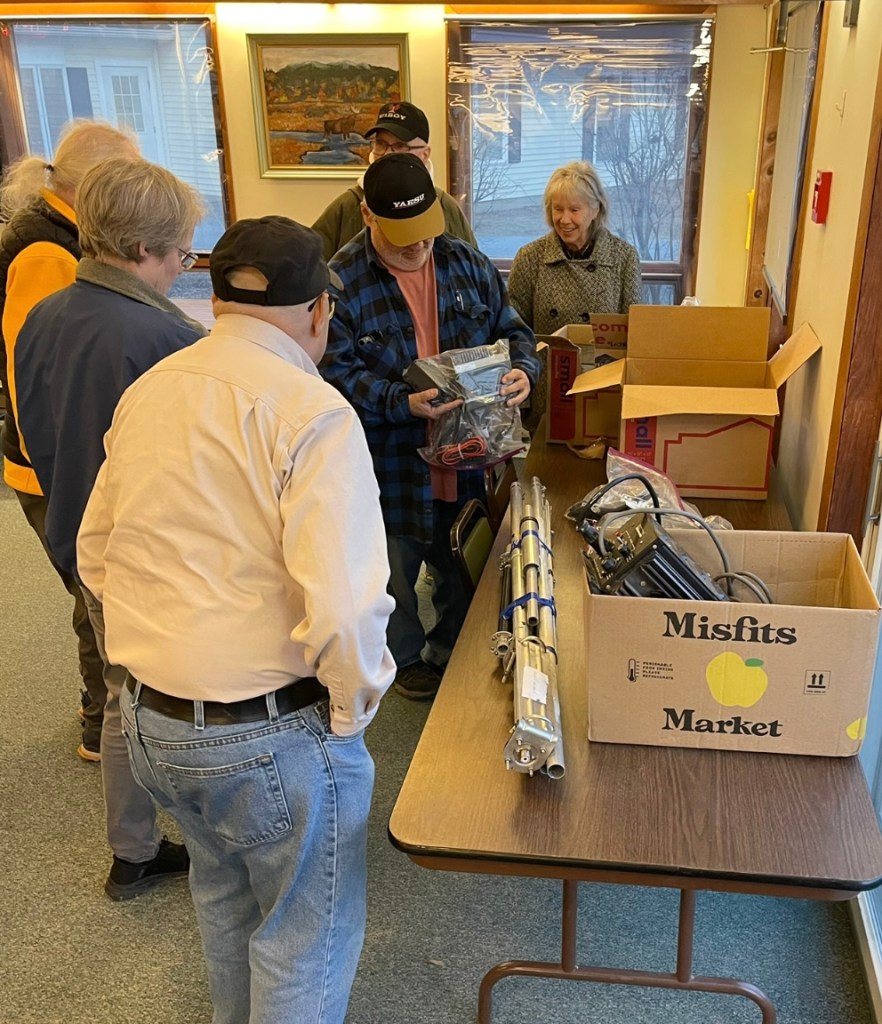
There was excitement over some equipment recently donated to the club.

Also coming soon is the EAWA Ham Radio Symposium scheduled for Saturday, April 5, from noon to 4:00. You will find a story about the symposium on this blog from February 21st. Updates and the final schedule will be posted here and many other ham radio websites and Facebook groups. 

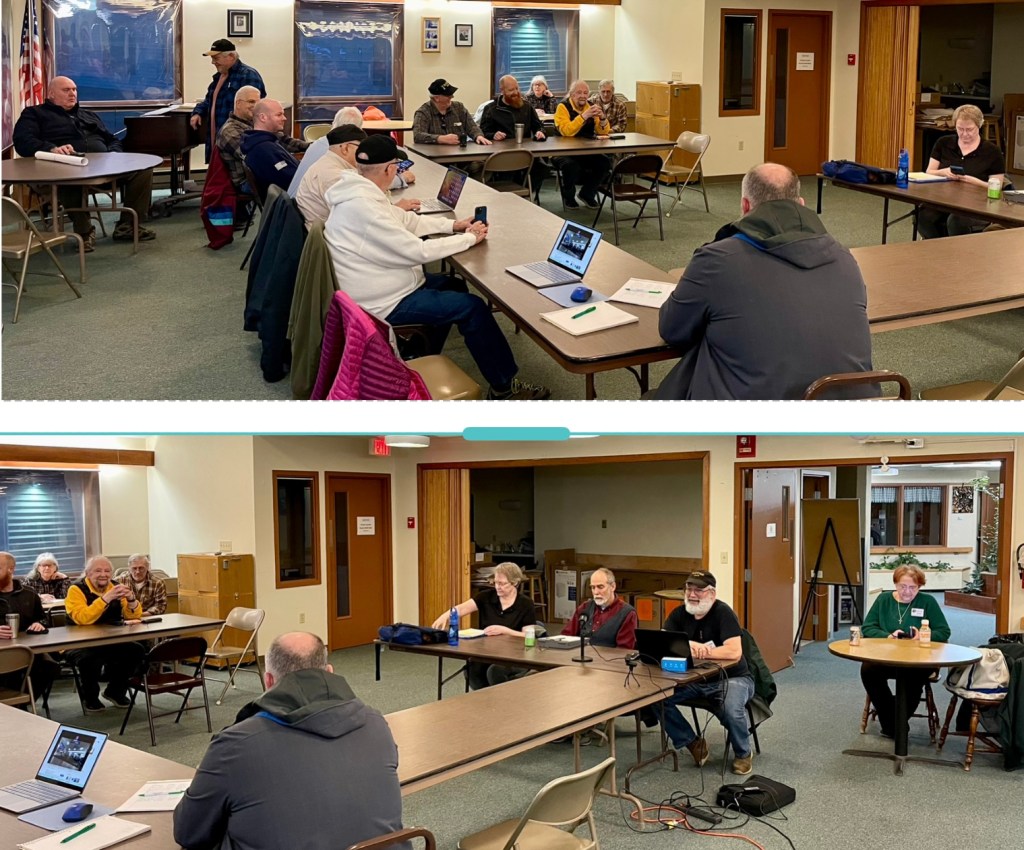
Much chatting and prepping going on here prior to the start of the meeting.

Maine-wide POTA Day is scheduled for Saturday, May 17th. As many of the EAWA members enjoy POTA, last year the consensus was that each member would participate individually. If there is interest, there may be a club gathering for POTA on that day. If you are new to POTA, a club event would be a great way to get acquainted with this popular radio activity.

For the featured website, Marion W1GRL showed the ARRL Learning Center (https://learn.arrl.org). This is a free service for all ARRL members. There are many courses available for studying for your first or next license, learning about emergency communications (both introductory and intermediate), designing lesson plans for classrooms, and understanding basic electronics. 

So many courses to choose from!

Following the business meeting, the program was a presentation on the CQ DX Marathon Program (https://dxmarathon.com), given by the Program Administrator, Mark WC3W. This is the current version of a long-standing contest once promoted by CQ Magazine. While this a program with many categories and awards, the program is also a way to track how you are doing in terms of contacting DX entities and CQ Zones. Mark emphasized fairness in terms of the creating level playing field categories, such as competing with those who have similar antennas and power outputs, and also in terms of honesty in reporting. Club competitions, including the most improved club score over the previous year, are gaining popularity.

In addition to the expected entry categories, you may enter for a single band, single mode, and use the WARC bands.

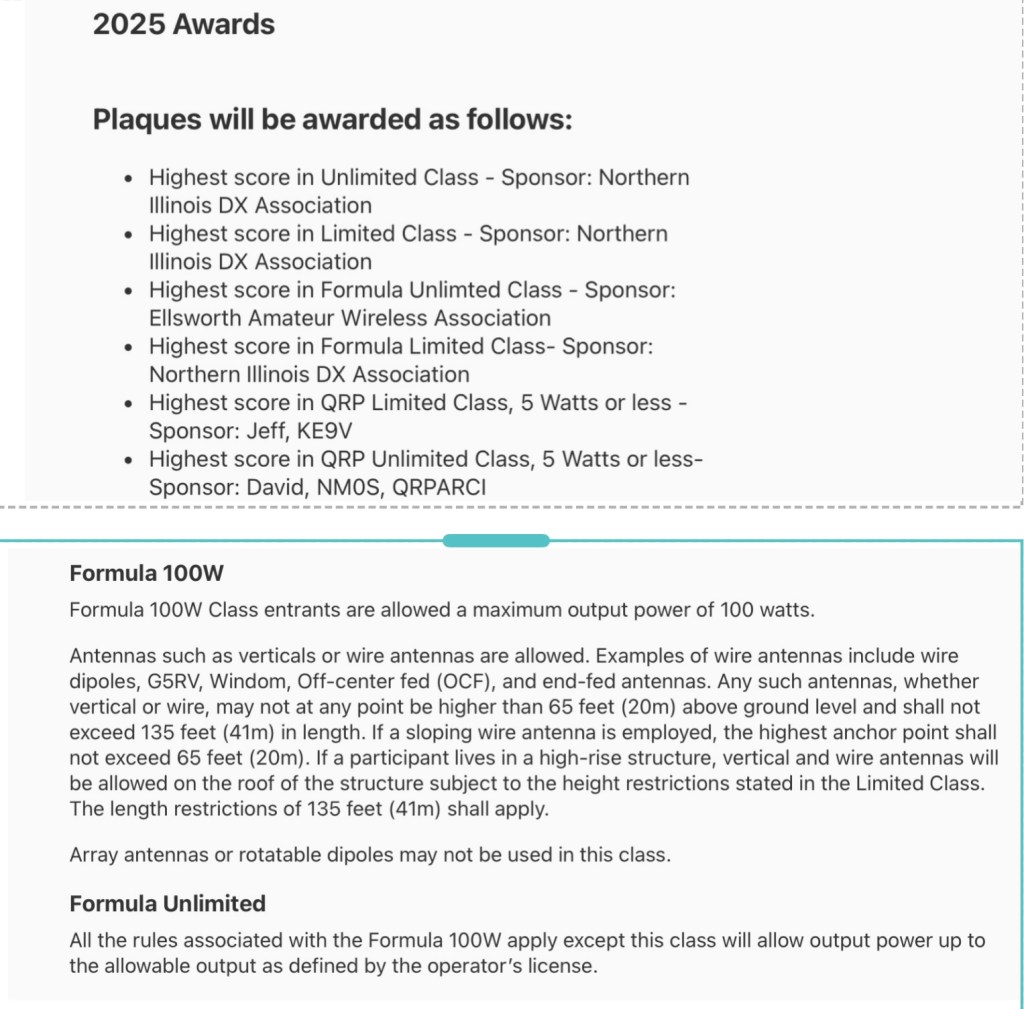
Last fall, Marion W1GRL and Stan W1BOY gifted the sponsorship of the winner’s plaque in a new category in the name of the EAWA. The new Formula Unlimited category is for those of us with more modest antennas who want to use our amplifiers. Mark thanked the club for sponsoring this new winner’s plaque.

It’s fun to know that whoever has the highest score in the Formula Unlimited Class (3rd plaque listed) will have a plaque in their shack with the Ellsworth Amateur Wireless Association engraved on it!

The March meeting was full of information and motivation to remain or get active with our diverse hobby. From emergency communications to POTA to DXing, there is always another avenue of ham radio to explore.
Written by Marion W1GRL

EAWA Lend & Learn Library Returns for March Club Meeting

Let’s try this again. This story was posted for the February club meeting, which was moved to Zoom due to difficult weather conditions. Lend & Learn is on for March! Maybe this will spark you to do a little Spring cleaning?!

Do you have extra amateur radio books or items to lend or give away? For example, we have several hams studying for their next license – are you going to use that old study guide? Perhaps you’ve upgraded some equipment, such as a soldering iron, or purchased the latest version of a book and the earlier edition is just sitting around? Someone who is just starting down that path may appreciate borrowing or taking some of those things that are just taking up extra space on your work bench or book shelf. 

Please bring any items you are willing to loan or give away to the next club meeting, scheduled for Thursday, February 13 at 7:00pm. Exchanges may occur before the meeting, during the break before the program, and after the program. Last August we held the first “EAWA Lend and Learn Library” event with good success! It was fun to see the items people brought and shared. Marion W1GRL borrowed a book on CW from Barbara KC1SSY and found it very helpful.

Each person who is willing to loan out an item is responsible for working out with the recipient how and when the item will be returned. Each person bringing items to give away is responsible for taking home whatever is left of what they brought. 

We are all in this together! Perhaps you have something to share that would make another hams journey a little better.
Written by W1GRL

Passion for Military Radio Support: Barbara KC1SSY & Bill KC2NMK

You can see the joy on their faces and hear the commitment in their voices as Barbara KC1SSY and Bill KC2NMK talk about their respective roles in the Military Auxiliary Radio System (MARS). They volunteer their time, radios, and skills to assist in various operations in the U.S. Air Force and U.S. Coast Guard. MARS includes the U.S. Army, Navy-Marine Corps, Coast Guard, and Air Force.

All of these auxiliary programs play a vital role in supporting military personnel and operations.

Barbara KC1SSY has had some connection to the military for many years. In high school she was in the Civil Air Patrol, later served in the U.S. Air Force for 8 years in the 1990s, and has remained active in veterans organizations. As her interest in amateur radio grew and she gained her licenses, she also began to learn more about the MARS. At the 2024 HamXposition in Marlborough, Massachusetts, she took the opportunity to meet with MARS operators and decided to join.

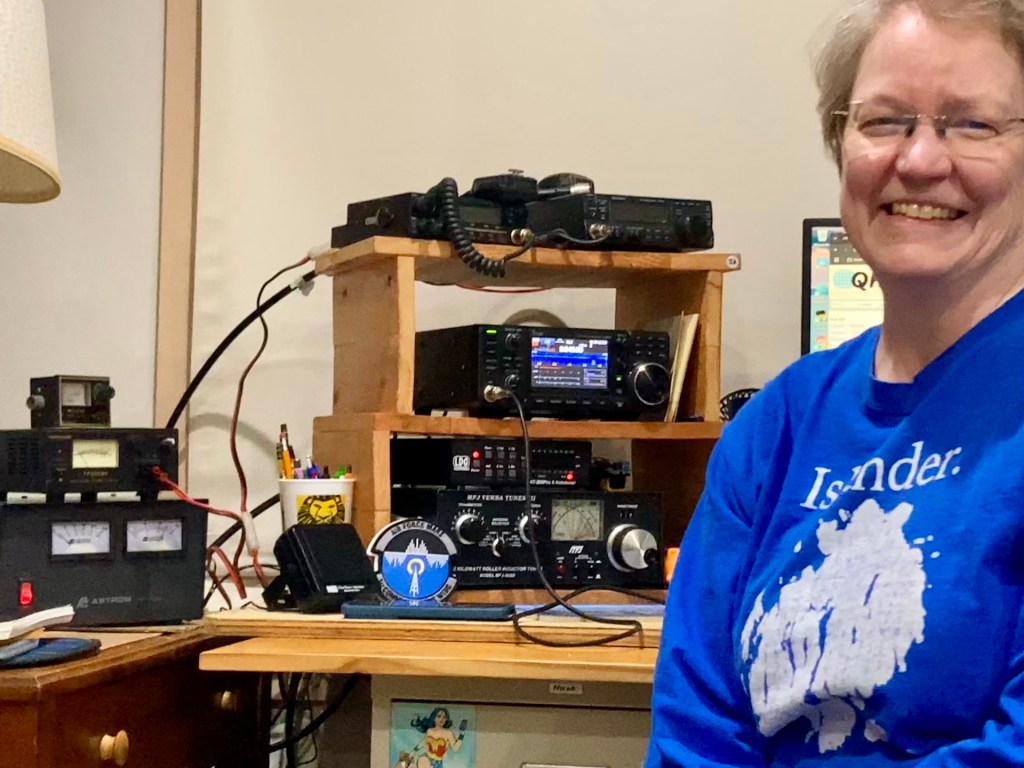
Barbara uses her equipment at home to execute her responsibilities.

Barbara is in the 1st wing of the U.S. Air Force MARS. The U.S. has 10 wings, with each operating up to two nets a day with digital and voice capabilities.They also engage in numerous preparatory exercises, from the wing to transglobal levels, along with providing services such as HF radio-telephone service for personnel. MARS support reaches to the DOD and the Pentagon by providing communications to airborne assets, message handling and delivery to the National Command Center. As a member of the MARS, Barbara spends approximately 8 to 10 hours a week in training or educational exercises and engagement with weekly nets. It’s clear that the friendships she’s made and the frequent contacts with MARS members brings Barbara much happiness and a sense of purpose.

Barbara KC1SSY is happy to share more information on MARS to anyone interested. Contact her via QRZ or through the “Contact Us” on this webpage.

Bill KC2NMK served in the U.S. Navy for 4 years in the 1970s, and then life took him in other directions. He reconnected with the military, specifically, the U.S. Coast Guard, when he relocated in Maine. After some inquiries, he quickly learned that amateur radio operations and being a part of the Coast Guard were good matches for him, and the station in Southwest Harbor, Maine, provided the perfect location. 

Bill volunteers his time primarily at the Coast Guard Station in Southwest Harbor, Maine.

As a part of the U.S. Coast Guard Auxiliary Telecommunication system, Bill engages in many roles, including quality control for weather monitoring. One of his primary roles is to serve as a Watchstander. Along with telecommunications assets, Watchstanders use HF, VHF, and repeater communications to support surface and air missions, including Marine Domain Awareness and joint military operations. Watchstanders participate in preparatory exercises so that during the loss of normal communications they can provide radio-based support for alerting, personnel recall, and the distributions of messages to officers and agencies in need of such information. In addition, participating in regional and district nets is essential. Bill spends approximately 16 hours a week in his auxiliary work, with most of that happening at the coast guard station. During this interview, his biggest smile came as he talked about times he has received a phone call asking if he could come to the station to help out. Similar to Barbara’s account, it’s clear Bill finds much happiness and sense of purpose in his auxiliary role.

Bill KC2NMK is happy to share more information on the Coast Guard Auxiliary to anyone interested. Contact him via QRZ or through the “Contact Us” on this webpage.

Both Barbara KC1SSY and Bill KC2NMK possess a wealth of knowledge and enthusiasm for their respective programs. It’s gratifying to know that, in addition to the many facets of radio operations most of us know, there is a strong, dedicated group working quietly to support our military personnel, exercises and missions.
Written by Marion W1GRL