
The annual Ham Radio Symposium, sponsored by the EAWA, was held on Saturday, April 5. In addition to the three speakers, there were several antennas to view, free pamphlets, and rotating slide shows to browse. There were also chances to win several raffle prizes and some home-made treats to enjoy. The Symposium began with words of welcome from Phil N1EP, the Maine ARRL Section Manager, and John KQ1P, the President of the Ellsworth Amateur Wireless Association.

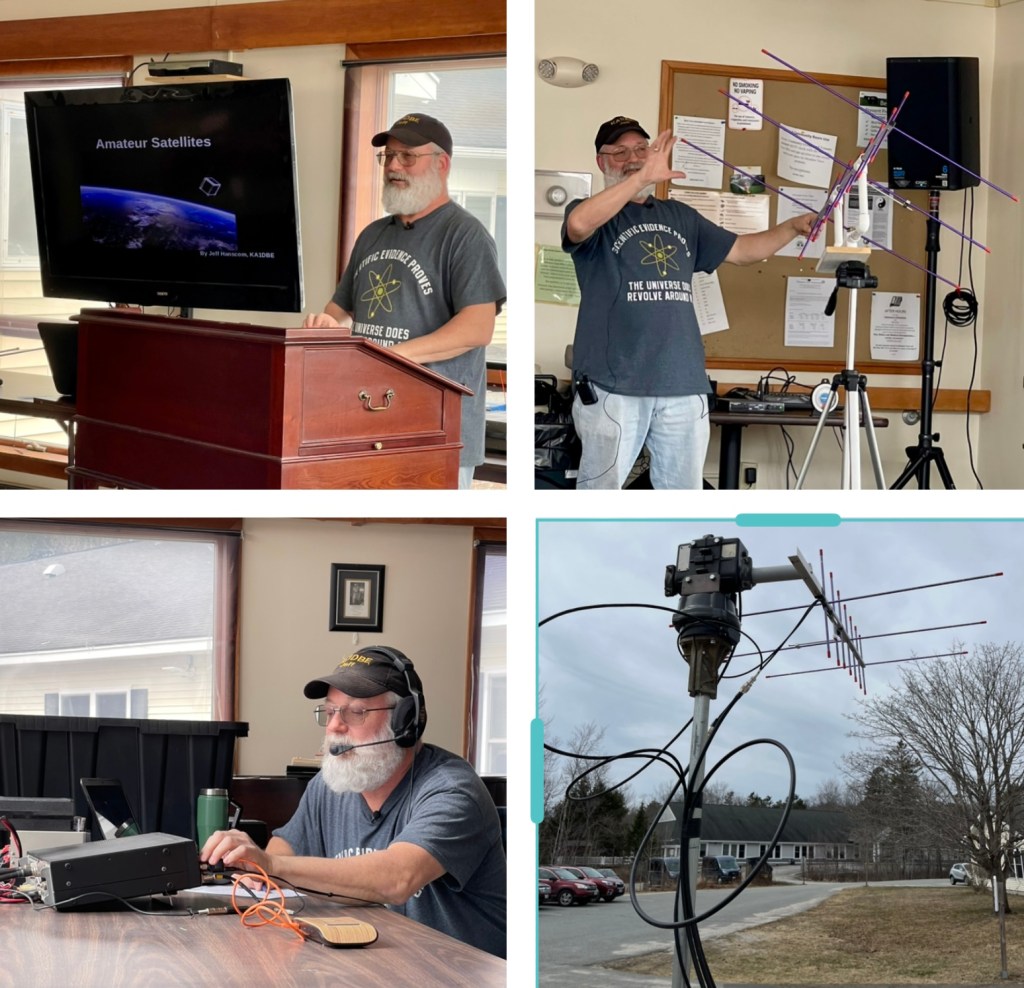
Jeff KA1DBE gave the first presentation on Amateur Satellites. Jeff’s engaging presentation intertwined the history of amateur radio and satellites along with covering the basic items needed. Operating via a satellite is similar to a using a repeater in that the activator sends a message to the satellite, and the satellite then returns the signal to the Earth. There are various configurations of satellites, such as FM satellites that can repeat only one transmission at a time, while linear satellites, which are used with SSB and CW, can handle several transmissions at a time. Jeff covered the information needed to track a satellite across the sky from one horizontal to the other. He reviewed software options along with several radio configurations for managing the transmission, and the types of antenna setups that work well. Satellites are traveling at great speeds, some tumbling as they go, so the antenna needs to be able to adjust quickly to those changes. Jeff also used one of his antennas to track satellite SO124 as it passed over the symposium room. We could hear voices clearly as it passed by.
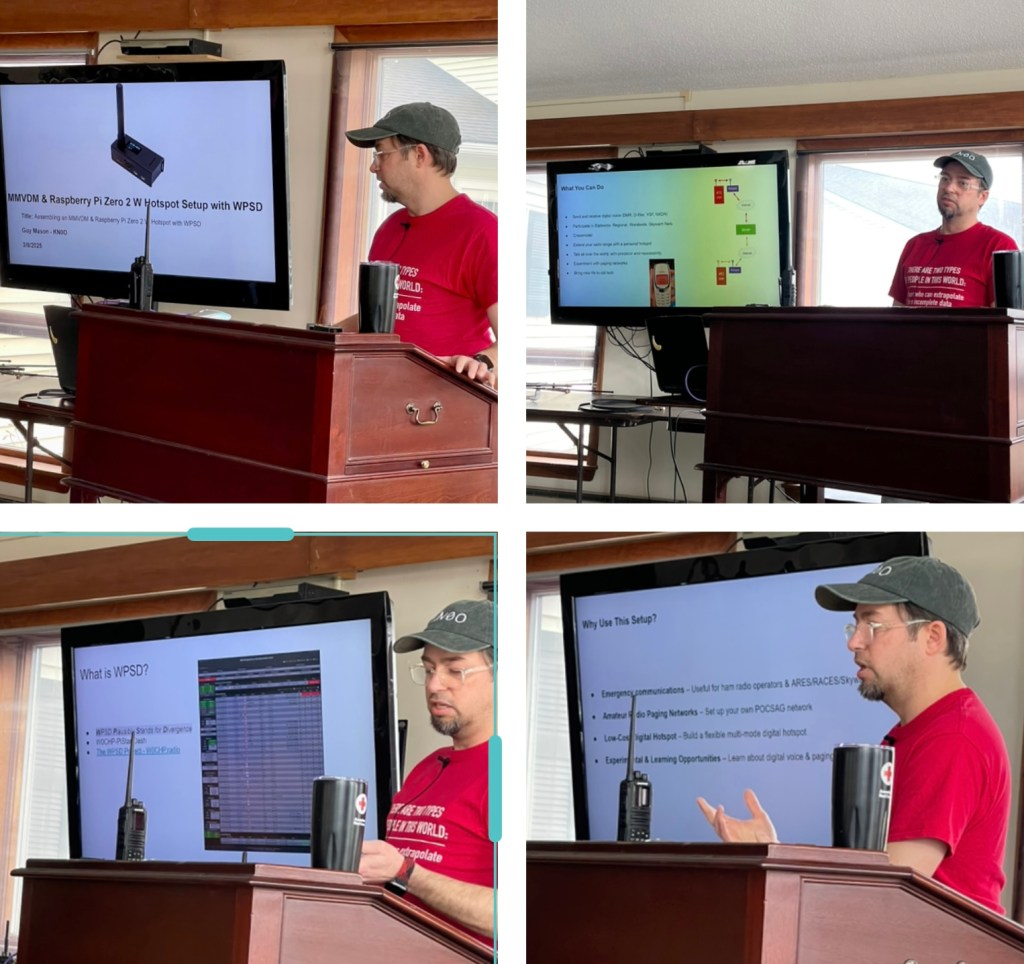
Guy KN0O gave the second presentation on Multi-Mode Digital Voice Modems (MMVDM) & Raspberry Pi Zero 2 W Hotspot Setups with WPSD. Examples of modes handled by a MMDVM include Digital Smart Technologies for Amateur Radio (D-STAR), Digital Mobile Radio (DMR), and Yaesu System Fusion (YSF). Guy gave examples of software uses for this kind of setup, such as sending and receiving digital voice, checking into nets, and extending your radio range. He then gave an informative tutorial on how to set such a system. He covered the required hardware, how to install and configure the WPSD software controls, and how to assemble the Pi Zero 2 W for this purpose. He had the hardware on site to show the details, down to the where to soldier parts together. He also demonstrated the potential for using an old pager as part of this process. He concluded by highlighting the benefits of this system: Emergency Communications, Amateur Radio Paging Networks, and Opportunities to Learn and Experiment.
Phil N1EP gave the final presentation on projects and information he found interesting and useful from the book Raspberry Pi 5 for Radio Amateurs, published by Elektor and authored by Dogan Ibrahim and Ahmet Ibrahim. Phil briefly introduced the Raspberry Pi 5, noting its capabilities and uses. He also introduced the book, including its coverage of basic electronics, hardware, and programming, and mentioned some of the many home-brew projects it detailed. For this presentation, Phil focused on ham radio software that can run on a Raspberry Pi 5, specifically when paired with a Software Defined Radio (SDR) dongal, such as listening to FM radio stations, operating WSJT-X, and setting up the Ham Clock display. Embedded in the discussion was also an overview of different types of SDR devices, with pros and cons of each.
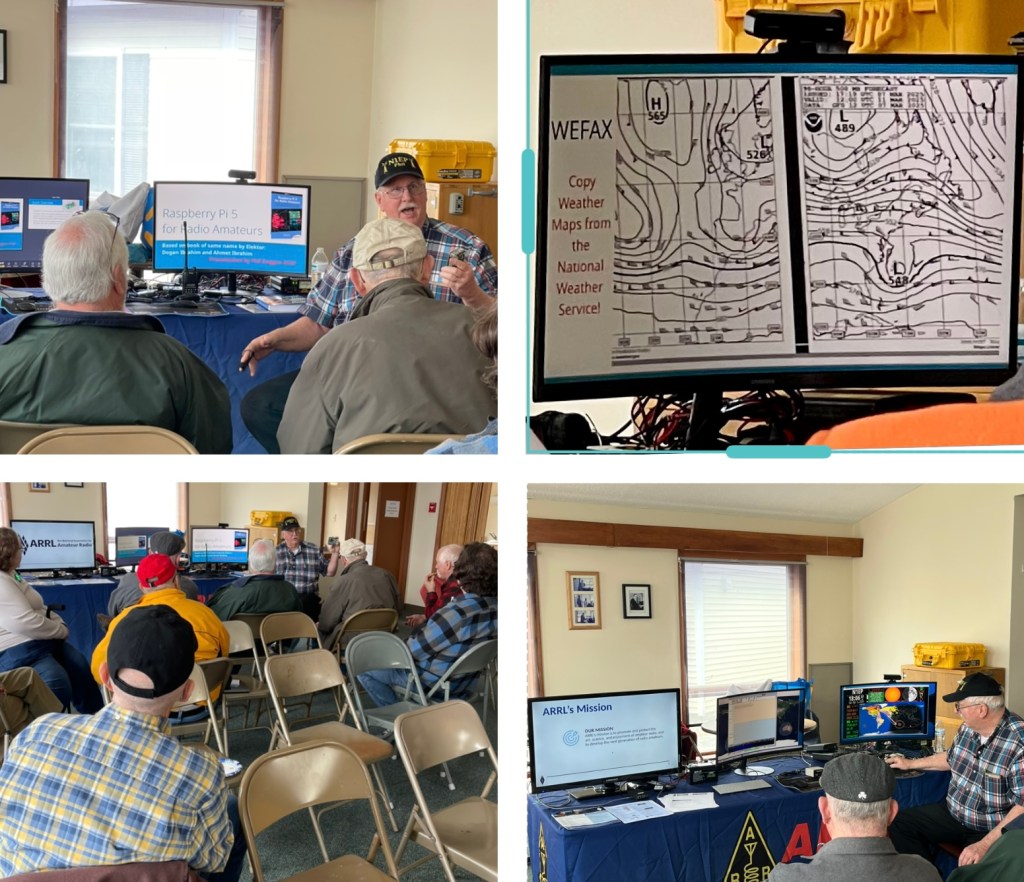
It was a fun-filled and information-filled afternoon! Raffle prizes included an ARRL Operating Manual, an RTL-SDR kit, a Baofeng UV-5RX3, an ARRL gift certificates, and a 50/50 cash prize. Many people deserve a heart-felt “Thank you,” for making this happen. At the risk of missing someone, those folks include: Joan W1DLC, Barbara KC1SSY, & Marion W1GRL for handling the sign-in and raffle tickets, Joan & Barbara for making treats and managing the food and drinks, Phil N1EP for advertising and almost all the items in the room (slide shows, special ARRL displays and literature, raffle prizes), Rob W8HAP for audio equipment and support, and the many people who helped set up the chairs and tables and then return them afterwards. This annual event is always a highlight for EAWA members, friends, and many in the community who join in. We are already looking forward to the 2026 Symposium!
Written by Marion W1GRL
 W1TU
W1TU 